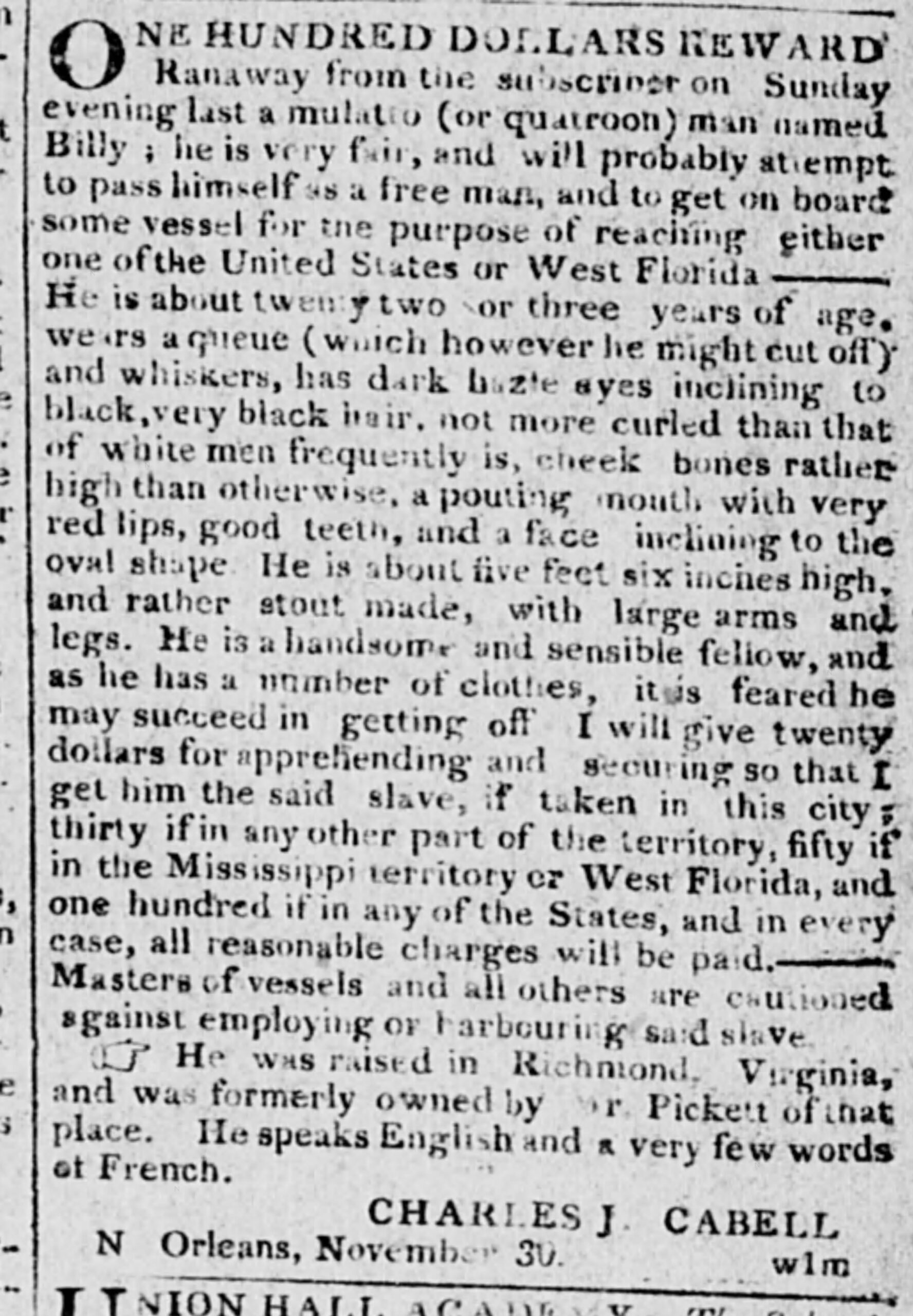
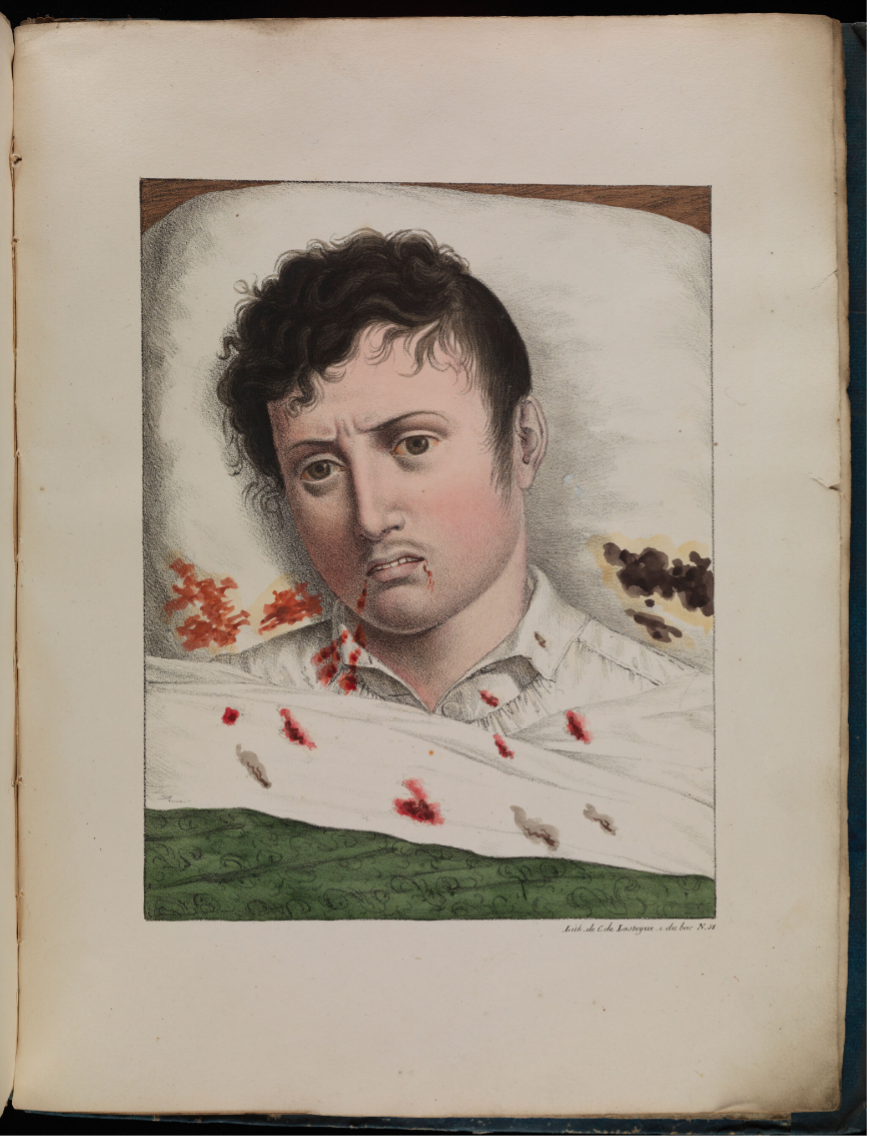
As the sun set over New Orleans on a November evening in 1810, Billy, an enslaved man, ventured into the city to escape his enslaver’s home. Billy was under significant strain, cleaning up after his enslaver, Charles Joseph Cabell, who had recently contracted yellow fever –a messy disease. Cabell’s residence had perhaps begun to stink of vomit and blood, and while Billy knew yellow fever was a fatal illness, he could not have known for sure that Cabell would succumb to the illness mere days after his escape.[1] One of Cabell’s final acts involved placing an advertisement for the capture and return of Billy. As his organs deteriorated, Cabell detailed Billy’s qualities in one last desperate act to re-obtain his lost property. The advertisement was sent to The Enquirer, a seemingly odd place for an advertisement seeking Billy’s return to appear. The Enquirer, after all, was a newspaper based in Richmond, Virginia, but Billy had escaped from Cabell in faraway New Orleans. Why pay for an advertisement in a city over a thousand miles away?
Cabell’s advertisement suggests he believed Billy wanted to and was capable of returning to his home state of Virginia. Billy was born around 1788 and grew up enslaved to a Mr. Pickett in the city of Richmond. At the time of Billy’s birth, Richmond was experiencing a period of growth after being named the capital of the state in 1780. Before receiving the distinction, the city was essentially nonexistent before the Revolutionary war.[2] While most enslaved people in Virginia lived and worked in rural agricultural settings, Billy likely grew up in this rapidly developing urban environment.[3] Billy surely spent hours of his adolescence maintaining his enslaver’s home under risk of beatings or other violence. Despite these conditions, Billy grew into the “handsome and sensible fellow” Cabell would later describe.
Charles Cabell also came of age in Richmond. Cabell, too, was born in 1788; however, while Billy inherited the status of a slave, Cabell was born into a life of opportunity as a member of Richmond gentry.[4] His father, Colonel Joseph Cabell served the Patriot side during the American Revolution and received an education at William & Mary.[5] Charles first attended Washington College and then trained in law at William & Mary. But Cabell was an unruly, short tempered young man which may have eclipsed his identity as a gentleman. In the spring of 1809, Cabell found his honor challenged by another student, Benjamin Jones, in a duel.[6] While Cabell left the engagement unscathed, Jones received a wound to his thigh that rumors suggested would hobble him for life. Both men were permanently expelled from William & Mary.[7]
In the aftermath of this incident, Cabell looked south for a new life in the port city of New Orleans. Arrivals to the city were near constant as Americans sought to take control of the recently acquired Louisiana territory and establish footholds in the burgeoning sugar and cotton industries. This economic transformation would turn New Orleans into a major importer of enslaved labor. Sometime before the move, Billy was purchased by Cabell and brought to a new city he had few ties to. Billy’s transition was likely anything but easy.[8] Coming from Richmond to New Orleans meant Billy was forced to adapt to a larger city, stickier climate, and new way of life. Yellow fever was common among newcomers like Cabell and Billy and surviving the disease was essential to establishing a life in New Orleans.[9] When the opportunity for freedom outside the disease-ridden city came, Billy took it. With his enslaver incapacitated, Billy likely headed for the harbor.
New Orleans’ diverse populations of Africans and Europeans meant it was not unusual to see someone like Billy with his mixed-race background and “very fair” complexion walking the streets of New Orleans unaccompanied. Cabell described Billy as a “quadroon”, a color term used to label people whose ancestry was imagined as being one-fourth African. At the time of Billy’s escape, this racist formulation was particularly in vogue around New Orleans in response to waves of mixed-race refugees arriving regularly from Saint Domingue.[10] Billy’s strategy was perhaps to blend in amidst this influx of peoples and possibly pass as a free man seeking passage away from Louisiana.
Billy could have seen a ship bound for Virginia, his birthplace, or he might have seen another ship headed for West Florida, a possibility Cabell highlighted in his advertisement. Around two months before Billy’s escape, settlers had established the short-lived Republic of West Florida. On October 27th, President James Madison ordered the governor of the Louisiana territory, William Claibore to take possession of West Florida. Perhaps Billy slipped through the cracks of this conflict into freedom.[11]
Charles Cabell died on November 23, 1810, before his advertisement could even be published in Virginia.[12] This, however, does not mean Billy was guaranteed freedom. Did Billy board a ship? Did he stay and make a new life in his new home? Was his search for freedom successful? While the outcome of Billy’s escape is unknown, his story reminds us that even as slavery was expanding across the new United States, so too were bids for freedom.
View References
[1] “N. Orleans, Nov. 24,” Virginia Patriot (Richmond, Virginia), January 1, 1811.[2] Ira Berlin, Many Thousands Gone: The First Two Centuries of Slavery in North America (Cambridge, Massachusetts: Belknap Press of Harvard University Press, 1998), 273.
[3] Ibid., 275.
[4]Alexander Brown, The Cabells and Their Kin, A Memorial Volume of History, Biography, and Genealogy, (Riverside Press, 1895), 462.
[5] Ibid., 288.
[6] Newbern Herald, no. 107, March 16, 1809.
[7] Virginia Argus, no. 1636, March 24, 1809; Jane [C. Charlton], Williamsburg, [Virginia], to Sarah C. Watts, Lynchburg, [Virginia], 19 March 1809, id108808, Box: 1. Sarah C. Watts Papers, Mss. 65 W34. Special Collections Research Center. https://scrcguides.libraries.wm.edu/repositories/2/archival_objects/149344 [Accessed May 22, 2026].
[8] Alexander Brown, The Cabells and Their Kin, A Memorial Volume of History, Biography, and Genealogy (Riverside Press, 1895), 462.
[9] Kathryn Olivarus, Necropolis: Disease, Power, and Capitalism in the Cotton Kingdom (Cambridge, MA: Harvard University Press, 2022) 5-10.
[10] Emily Clark, The Strange History of the American Quadroon: Free Women of Color in the Revolutionary Atlantic World (Chapel Hill, University of North Carolina Press, 2013) 5, 38-39.
[11] Henry Marks, “Boundary Disputes in the Republic of West Florida in 1810,” Louisiana History: The Journal of the Louisiana Historical Association 12, no. 4 (1971): 355–65. http://www.jstor.org.ezproxy.library.wisc.edu/stable/4231217.
[12]“Mortuary Notice,” Virginia Patriot, January 1, 1811.