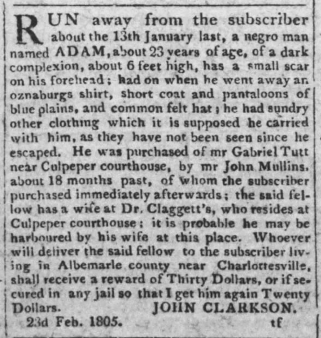
On February 23rd, 1805, a notice appeared in the Richmond newspaper the Virginia Argus, seeking the capture and return of an enslaved man named Adam. The advertisement described Adam but revealed little of what exactly he was escaping from or how he hoped to find freedom. Just five years earlier, an enslaved blacksmith named Gabriel had planned a massive uprising in Richmond. Gabriel and his co-conspirators intended to seize the Virginia State Armory, but the plot was leaked before its execution. While the rebellion failed, it reminded White Virginians of the violent retributions they might face if enslaved people resisted. In response, Virginia’s assembly passed new laws strengthening slavery and restricting the rights of free Black people. White Virginians entered the new century afraid, and that fear had teeth.[1]
It was into this world that Adam escaped. He fled from John Clarkson’s plantation in western Albemarle County, just a few miles from Thomas Jefferson’s Monticello, likely without the pass required by law. Virginia’s 1705 Slave Code required any White Virginian to stop and detain any Black person who did not carry a pass. John’s advertisement only added to the danger that someone would stop Adam. Perhaps Adam carried a forged or stolen pass, but even if he was able to travel and remain free, he remained vulnerable to being recognized and recaptured.[2]
There are various possible reasons for the six-week gap between Adam’s escape and John’s advertisement. Perhaps John failed to immediately notice that Adam was absent. Alternatively, John may have waited for a while, thinking that Adam was engaged in petit marronage, a temporary absence, and that Adam would soon return. It is also possible that local search parties came back empty-handed, and the advertisement in a Richmond newspaper was a last resort. Planters admitted that slave patrols were sometimes inadequate, struggling to catch determined runaways. [3]
The advertisement suggests that Adam may have been headed toward Culpeper County, forty-five miles northeast of Albemarle, where he had previously lived and where a Dr. Samuel Claggett allegedly held his wife in bondage. John used the word “wife” in his advertisement despite marriages between the enslaved had no civil standing.[4] But whatever White Virginians’ laws said, Adam surely considered this woman to be his wife. Perhaps John was right, and Adam was indeed risking everything to be with his partner. Indeed, the relationship betrayed a likely motive for Adam’s escape as well as a suspected destination.
Adam’s situation was excruciating. Staying in Albemarle with his new enslaver meant accepting permanent separation, divided by distance and ownership. But running risked his life. Failure on a first escape would make a second bid for freedom much more difficult: he would henceforth be marked as a runaway and under far greater scrutiny. John understood this, warning that Adam “may be harboured by his wife,” pointing to a deeply human vulnerability: love. She was likely both the reason Adam fled and the trap that might lead to his capture. Even more tragically, she was enslaved herself —if they reunited, there would be no resolution. While they would no longer be separated, they would both remain in bondage, with Adam in hiding and in constant danger of being detected and recaptured.
But Adam ran anyways into the dead of winter with little clothing. The osnaburg shirt on his back, a loosely woven linen garment, offered poor insulation. His “blue plains” pantaloons, likely coarse wool, were stiff and uncomfortable. He likely had shoes of some kind, for without them, frostbite would have been a near certainty in the foothills of western Virginia. Thanks to Thomas Jefferson’s weather records at Monticello, we know what Adam was walking into. The day before his escape, January 12th, temperatures dropped to seven degrees Fahrenheit. The day after he escaped, a snowstorm hit. By late January, more than seven inches of snow blanketed the landscape, holding up even well-equipped travelers. Blizzard conditions may have obscured the ability of patrols to see and pursue freedom seekers, but they may also have driven Adam toward nearby plantations out of desperation for warmth.[5]
Leaving Albemarle meant descending from the Blue Ridge foothills, crossing into some of Virginia’s most rugged terrain. Rocky crevices and passes offered cover from patrols but little warmth or food. More likely, Adam survived on what could be taken quietly– frozen berries, dried corn if he dared to approach a barn, or stolen rations. None of it was sufficient for the strain of constant movement, but it may have been enough to keep him going. He would have needed all the strength he could muster to navigate Albemarle County’s treacherous clay-rich terrain, the same red clay loam documented at Monticello, which winter freeze–thaw cycles turned into a soft, unstable mud. Movement would have been slow and exhausting. Travelling at night, as he likely did to avoid detection, meant navigating obstacles in the dark. However, the landscape was also his ally, with the mountains serving as a natural compass; keeping them to his left would guide him towards Culpeper.
Adam would eventually face the Rapidan river, the final barrier before Culpeper county. It was broad, cold, and not easily crossed in January. Raccoon Ford was the primary crossing, and for Adam to get across, he would have needed to slip across undetected or negotiate with a ferryman. He would have to hope the ferryman accepted whatever story or forged documents Adam produced, or that he was susceptible to bribery. These ferries depended on moving people, not policing them, so a few coins might have been enough to secure passage, which some ferrymen accepted from unaccompanied Black men and women.[6] But bribery required money, and those coins had to come from somewhere. Possibly he had been able to save a small amount while enslaved. Farms and homesteads along his route may have also presented opportunities. But any thievery had little margin for error. Whatever luck Adam needed, he would have had to make himself.
After the appearance of the newspaper advertisement, the record goes quiet. The silence after John’s advertisement may have meant that Adam had frozen to death, and that his body was never found or identified. Perhaps it meant that he had found his wife, and either managed to create a new life for himself nearby, or that the couple had then escaped together. What the record does show is that escaping at the worst possible time of year, Adam had chosen to risk his life and run anyway. In the middle of winter, in summer clothes, he attempted to cross forty-five miles of mountains and a freezing river. That decision, that driving desire to be free and with his partner, is the only thing that Adam left behind.
View References
[1] Douglas R. Egerton, Gabriel’s Rebellion: The Virginia Slave Conspiracies of 1800 and 1802 (Chapel Hill: University of North Carolina Press, 1993), 208; Samuel Shepherd, ed., The Statutes at Large of Virginia, from October Session 1792, to December Session 1806 (Richmond: Samuel Shepherd, 1836), 3:251–253.
[2]Paul Heinegg, “Albemarle County Personal Property Tax List, 1782–1813.” Free African Americans of Virginia, North Carolina, South Carolina, Maryland and Delaware. Library of Virginia microfilm nos. 5, 6. freeafricanamericans.com/albemarletax.html [accessed May 6, 2026]; Netti Schreiner-Yantis and Florence Speakman Love, The 1787 Census of Virginia (Springhill, Virginia: Genealogical Books In Print, 1987), 136; William Waller Hening, ed., The Statutes at Large; Being a Collection of All the Laws of Virginia from the First Session of the Legislature, in the Year 1619, (Philadelphia: R. & W. & G. Bartow, 1823), 3:447–463; Douglas R. Edgerton, “Gabriel’s Conspiracy and the Election of 1800.” The Journal of Southern History 56, no. 2 (May 1990): 191–214.
[3]Sally E. Hadden, Slave Patrols: Law and Violence in Virginia and the Carolinas (Cambridge: Harvard University Press, 2001), 111.
[4] Tera W. Hunter, Bound in Wedlock: Slave and Free Black Marriage in the Nineteenth Century (Cambridge: Harvard University Press, 2017) 12.
[5] Thomas Jefferson, Daily Weather Record at Monticello, January 1-February 28, 1805, Massachusetts Historical Society: Coolidge Collection of Thomas Jefferson Manuscripts, accessed via Jefferson Weather & Climate Observations Project, https://jefferson-weather-records.org/node/40924 [accessed May 6, 2026].
[6] Ann Brush Miller, ed. Orange County Road Orders, 1734–1749. Richmond, VA: Virginia State Library, 1985, 5; Gerald W. Mullin, Flight and Rebellion: Slave Resistance in Eighteenth-Century Virginia (New York: Oxford University Press, 1972), 113.