Sall (March 1783)
Her Fire
By Alexandra Holubowicz
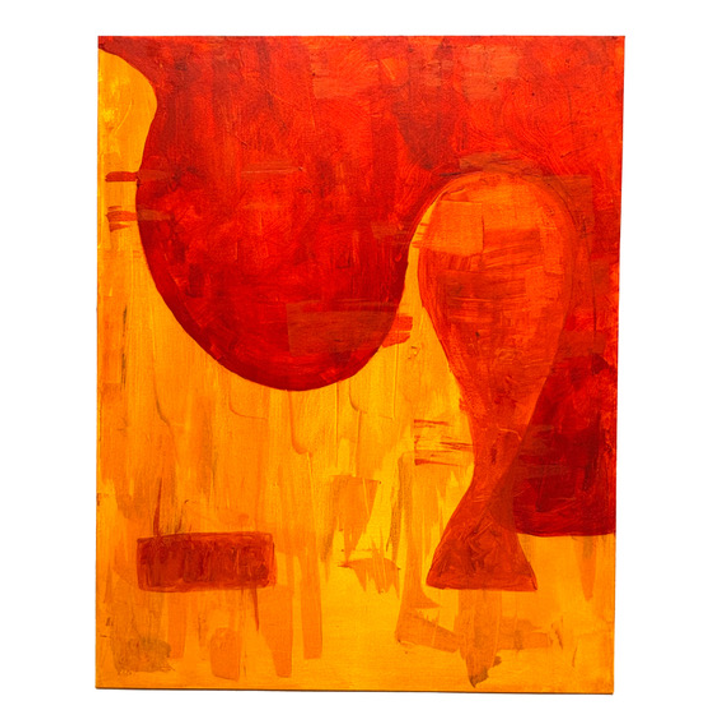
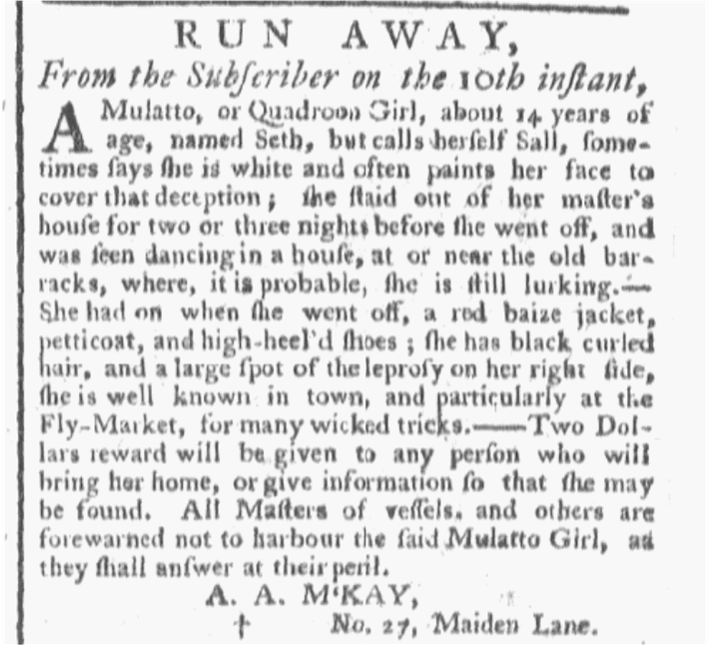
Her Fire was inspired by Sall. The advertisement describes a 14-year-old girl who avoided capture by making friends, adopting different identities, and always staying one step ahead of her enslaver with her “wicked tricks”. What stands out in particular is the fact that she was reported wearing “red baize jacket, petticoat, and high-heel’d shoes,” clothing which would make her stand out rather than disguising her. I chose this story because I was interested in exploring how Sall managed to avoid capture while expressing herself through her flamboyant fashion.
I chose to create a painting as my medium because I wanted to capture the vibrant essence of Sall rather than making the piece feel too representational. I chose to abstract flounces, which were typically found on women’s clothing at the time, and the high heel Sall was described to be wearing.[1] I chose to abstract features of her outfit because Sall’s appearance was fluid and I did not feel that her specific outfit defined her. I was more interested in her choice of clothing when she escaped, and what it revealed about her.
The color palette of the painting was inspired by the significance of the location in which she lived and then escaped. In her story about Sall, Olivia Barnard wrote that:
Nearly seventy-one years before fourteen-year-old Sall traversed the neighborhood, a group of at least twenty Africans set fire to an outhouse on the same street to signal the beginning of an armed struggle to end slavery. Met by local militias, the revolutionaries who participated that night risked their lives to overthrow the institution in New York.[2]
During Sall’s lifetime some African men were securing freedom by joining the British cause; however, as a woman Sall was unable to participate in such efforts. I interpreted Sall’s escape and dress as her own “fire,” or contribution to the cause of abolishing slavery. I chose my color palette based on the colors of fire: red, orange, and yellow. The abstracted flounces at the top of the piece are red, the high heel orange, and the terrain in the background is yellow. I initially wanted each section of color to be flat and very crisp, but once I began using the medium, I experimented with layering various tones of each color to mimic a fire, as I felt it better represented Sall’s assorted personas.
When viewers look at my painting, I hope they can feel Sall’s bold presence. Enslaved individuals are often only documented and remembered for characteristics which would assist in their recapture, such as their clothing and physical traits, emphasizing how they were viewed as property rather than a real person. Sall’s advertisement discussed her strategies to avoid capture, her clothing, and the places she was known to visit, as well as a warning to whoever encountered her path not to fall for her “tricks.” This short advertisement of Sall may be the only surviving words recording her existence, yet they reveal very little about her and nothing about the rest of her life before and after her escape. Working on this piece about Sall has made her feel like more than just words in a newspaper, enabling me to think about and represent the bold and witty young woman she was. Her story is important and worth remembering, as are the stories of other enslaved individuals. I feel as though my creative piece helps memorialize her as the intricate and intelligent human being she was, rather than the spiteful and childish enslaved girl the advertisement tried to portray her as.
Sall’s story, despite the advertisement’s shallow description only created with the intention of recapturing her, demonstrates the complexity behind her and other freedom seekers’ personalities and lives. Through examining her strategies, fashion choices, and the historical landscape she lived in, I came to understand her as the expressive and resourceful young woman she was. Creating this piece allowed me to honor her defiance and her “fire,” and to restore the dignity that history tried to erase.
View References
[1] Linda Baumgarten, What clothes reveal: The language of clothing in colonial and Federal America: The Colonial Williamsburg Collection (New Haven: Colonial Williamsburg Foundation, in association with Yale University Press, 2002).
[2] Olivia Barnard, “Sall (March 1783), Freedom Seekers, https://freedom-seekers.org/story/sall-march-1783/ [accessed May 16, 2026].