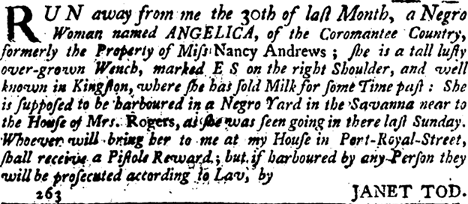
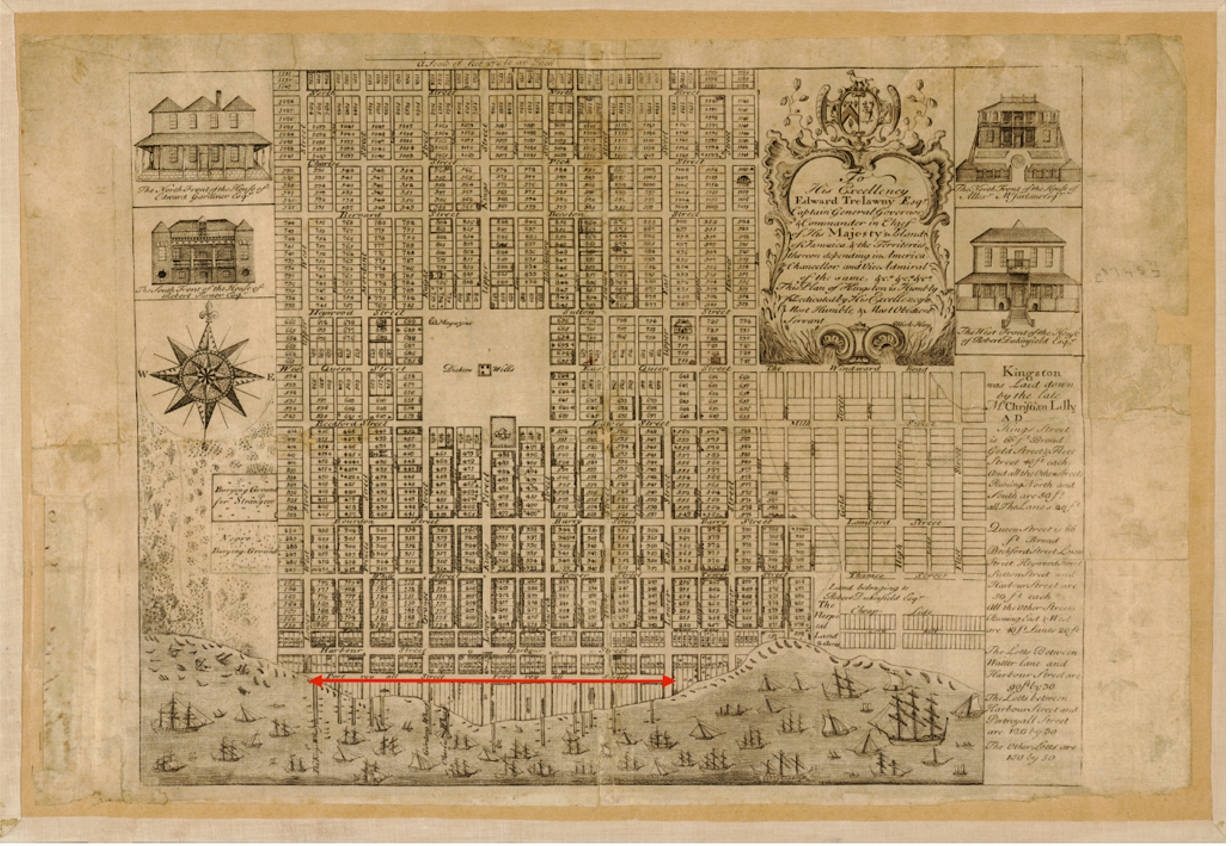
When Angelica fled her enslaver’s home in Kingston, Jamaica, on September 30, 1761, she likely slipped into a hectic scene. Port Royal Street, where Janet Tod’s home stood, bustled with free and enslaved people tradesmen, store-keepers, seamstresses, sailors, customers, and pedestrians, all filling the street that faced the city’s harbor. As Angelica moved through the crowded street, her next steps were likely shaped by an intimate knowledge of this urban space. This complex multi-racial society had been rendered unstable by a recent slave rebellion that had enflamed racial tension between White Jamaicans and the larger enslaved population. It was a dangerous time to escape, and Angelica must surely have depended upon friends and connections for aid and protection.[1]
The advertisement posted in The Kingston Journal in October reveals elements of this larger backdrop in some of the details about Angelica. The notice identified that Angelica bore the letters “E.S.” branded on her “right shoulder,” suggesting that prior to this she had been enslaved by somebody bearing those initials. While the origins of this branding remain unclear, it served as a visible marker that distinguished Angelica to her pursuers.
The advertisement’s emphasis on Angelica’s branding may have been an attempt to differentiate her within a crowded and mobile population of enslaved and free women in Jamaican towns and markets. Tod further described Angelica as “well known in Kingston,” noting that she had sold “Milk for some Time past.” This suggests that Angelica had worked as a “higgler,” or market woman. Such labor would have afforded her considerable freedom of movement and placed her in constant contact with the public, both White and Black. This mobility likely served Angelica well. Higglers may well have escaped at higher rates than other enslaved women, in part because their work allowed them to cultivate informal networks and knowledge of urban spaces, and to roam freely about towns and countryside.[2]
The advertisement’s description of Angelica as being “of the Coromantee Country” was highly significant. Angelica made her escape in the aftermath of one of the largest slave rebellions in Atlantic history, Tacky’s Revolt. Beginning in April 1760, around fifteen hundred Black men and women took advantage of the chaos ensuing from Britain’s Seven Years’ War against France and Spain to stage an enormous rebellion that continued for nearly a year. The revolt resulted in the deaths of roughly sixty White colonists and more than four hundred enslaved people, many of whom were executed with extreme brutality. Although the rebellion had largely subsided by September 1761, its effects remained immediate and pervasive.[3]
Fear surely gripped much of Kingston’s White population in the rebellion’s aftermath. Jamaican planters widely believed that the revolt’s leaders were Coromantee — an assumption grounded in rumor, eyewitness testimony, and long-standing racialized ideas about people from the Gold Coast of Africa. There was no such region or people in coastal West Africa, and Coromantee was a White construction applied to people who were shipped to Jamaica from the Gold Coast, which is in present-day Ghana. Jamaican enslavers came to think of the people they called Coromantee as proud, warlike, and strong, and thus as able plantation workers but also as potentially dangerous rebels. Governor Christopher Codrington displayed this view in 1701 when describing Coromantees as “grateful and obedient to a kind master, but implacably vengeful when ill-treated.” Throughout the summer of 1761, rumors of new conspiracies kept slaveholders fearful of continued violence.. Indeed, that July, enslaved rebels in Kingston rallied behind a woman named either Qubah or Akua, whom they dubbed “the Queen of Kingston.” This woman rallied mass support and claimed territory in and around Kingston before being transported from the island by the government. Whether Angelica was involved in or aware of this mobilization at this time is uncertain, but its presence would have been hard to ignore. By identifying Angelica as Coromantee, Tod maybe sought to leverage public paranoia and encourage vigilance among Kingston’s frightened White populace. Yet in spite of these efforts, Kingston’s dense urban environment and Angelica’s established networks as a higgler likely provided her with the mobility and connections she needed to disappea.[4]
The advertisement offers clues as to where Angelica may have gone. Tod suspected that she was harbored in a “Negro Yard in the Savanna near to the House of Mrs. Rogers.” The Savannah was likely in the agricultural area north of Kingston, in the foothills of the Blue Mountains. A “Negro Yard” referred to the slave quarters and their vegetable patches, the area of a plantation reserved for the enslaved workforce. Freedom Seekers might well seek to find refuge in slave quarters, hidden away from enslavers. Perhaps Angelica was returning to a partner, family members, or friends in the enslaved communities near to the site of her enslavement by Nancy Andrews. The network Angelica may have built during her labor in Kingston likely led her to this yard, where she was familiar and well-connected.[5]
It was there that Angelica may have found comfort, aid, and guidance for her next steps toward liberty and self-determination. If she were to seek out her connections at the yard, she would first need to blend into Kingston’s roads, which, as a higgler, she knew well. Any ease she felt while moving concealed amid the sea of people of color would have been marred by the corpses of rebellious enslaved people hanging in chains on Kingston Parade in the center of town, stark reminders of the rebellion’s brutal aftermath.[6] Despite the massive risk, Angelica used her knowledge and informal networks throughout Kingston to find a place where others would help in her escape. Whatever her ultimate fate, it was the relationships that Angelica had quietly cultivated in Kingston’s markets, streets, and yards, and her longstanding friendship and perhaps family connections with people on plantations north of Kingston that may have given her the means to disappear.
View References
[1] Simon P. Newman, “Hidden In Plain Sight: Escaped Slaves in Late Eighteenth- and Early Nineteenth-Century Jamaica.” William and Mary Quarterly (2018), 41, 24-25, 41; Trevor Bernard and Emma Hart, “Kingston, Jamaica, and Charleston, South Carolina: A New Look at Comparative Urbanization in Plantation Colonial British America,” Journal of Urban History 39, no. 2 (2013), 222; Census data from 1788 records 16,659 slaves, 3,280 people of color, and 6,539 white men, women, and children living in Kingston. In the urban parishes of Kingston and Port Royal, slaves and free people of color made up 77 percent of the population. “Return of the Number of White Inhabitants Free People of Colour and Slaves in the Island of Jamaica,” Spanish Town, November 1788, CO 137/87, p. 173, transcribed in Jamaican Family Search Genealogy Research Library, https://www.jamaicanfamilysearch.com/Samples2/1788tab.htm [accessed May 1, 2026].
[2] Trevor Bernard and Emma Hart, “Kingston, Jamaica, and Charleston, South Carolina: A New Look at Comparative Urbanization in Plantation Colonial British America,” 21, 24.
[3] Vincent Brown, Tacky’s Revolt: The Story of an Atlantic Slave War (Harvard University Press, 2019), 164; Vincent Brown “Slave Revolt in Jamaica, 1760–1761: A Cartographic Narrative,” (accessed March 26, 2026); Newman, “Hidden in Plain Sight,” 7.; Vincent Brown “Slave Revolt in Jamaica, 1760–1761: A Cartographic Narrative,” http://revolt.axismaps.com/ [accessed March 26, 2026].
[4] Brown, Tacky’s Revolt, 130, 89, 164, 162.
[5] Wilma Baily, “What the Yard is Said to Be,” Social and Economic Studies, Vol 25 no. 2 (1976), 168-174. A 1770 law stipulated that owners must account for all slaves and freed people residing in yards, enslavers feared that these spaces where slaves sought to form “cabals and conspiracies dangerous to the public peace and security.” Above all, yards were likely islands of community and refuge for freed and enslaved blacks in a society in which they had no stake; Baily, “What the Yard is Said to Be,” 171.
[6] Newman, “Hidden in Plain Sight,” 10, 33.