On the night of January 22, 1778, in a hospital near the Patriot encampment at Valley Forge, Caesar Cole must have felt the chill creeping into his extremities.[1] It was a cold that no blankets, proximity to the fire, or any other remedy could cure—it was a cold that foretold his demise. Caesar’s illness is unknown, but it was agonizing and unrelenting. He had been sick since at least December 18, with no signs of recovering. In a moment of clarity, perhaps Caesar reflected on his journey, transporting himself seven years back in time to that wintery November night when he had made his bid for freedom.[2]
Little is known about Caesar before his escape. His enslaver was Benjamin Cole—a Warren, Rhode Island man who was the deacon of the local Baptist Church. Caesar performed a variety of tasks for Benjamin’s family and was possibly hired out to assist the town’s shipbuilding industry—an industry dependent on the slave trade. As Christy Clark-Pujara observes, more trafficking voyages left from Rhode Island harbors than all other American colonies combined. Furthermore, Rhode Islanders constructed the ships, supplied enslavers with food and clothing, and assisted in “the maintenance of slaveholding in the Americas.” Caesar escaped from the hub of the North American slave trade, a symbolic challenge to the institution that oppressed him and so many others.[3]
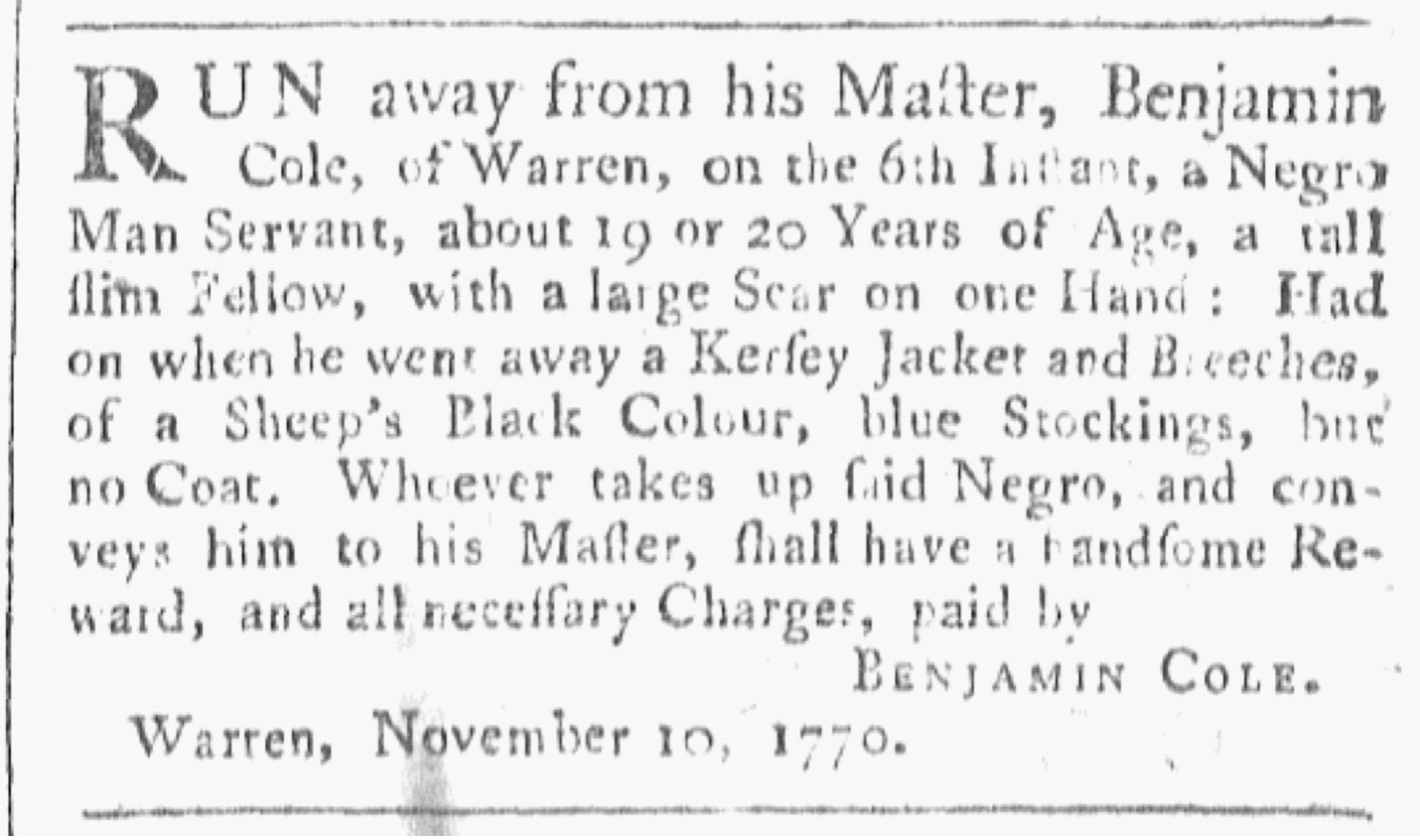
On November 6, 1770, Caesar mustered the courage to liberate himself. His success was far from certain—he had fled from an enslaver with extensive church and family connections in the slave trade’s most vital colony. He remained undaunted, dashing out without a coat despite the November weather: perhaps this was a spur of the moment action, rather than a long-planned escape for which he had prepared. Steadfast in his pursuit of freedom, Caesar vanished from the historical record for the next half decade, evading both his pursuers and those seeking to piece together his story. Against impossible odds, he got away.[4]
In May 1776, Caesar re-emerged as a private in the Continental Army. His enlistment occurred at a pivotal moment in the Revolution, when the Patriots were recruiting able-bodied men regardless of skin color to preserve their fighting force. Caesar served for at least two months, most likely engaging in menial and undesirable tasks such as foraging, cooking, and digging entrenchments and latrines. He also likely encountered discrimination from soldiers who disapproved of his service. As the colonies proclaimed their independence from British rule, Caesar persevered through all adversity to claim his wages in July 1776.[5]
Following this term of army service Caesar appeared in March 1777 aboard the USS Warren. It was common to receive African Americans into the Continental Navy owing to the tradition of Black participation in seafaring industries. Unfortunately, calamity struck, as Benjamin’s family discovered him and requested his release into their custody. The extent of the Navy’s compliance with this request is unknown, but Caesar must have deeply anguished. After almost six years of liberty, he was threatened with a return to the system that condemned him as property.[6]
Just as it appeared that he would once again be consigned to bondage, Caesar reenlisted in the Continental Army for a term of three years. In 1778 the Rhode Island Assembly would pass a law allowing enslaved men in the state to join the Continental Army: their enslavers would be compensated by the state, and at the end of their service the men would be free. Perhaps Caesar was one of the enslaved Rhode Islanders who anticipated and helped trigger this law, coming to an arrangement with Benjamin. Or perhaps he simply joined of his own accord. Whatever the case, it was probable that at the end of his contract with Colonel Christopher Greene’s 1st Rhode Island Regiment, Caesar would have been legally free. For Caesar, a light at the end of the tunnel had emerged. All he had to do was follow it.[7]
However, the realities of war stood in Caesar’s way. In late October, the 1st and 2nd Rhode Island Regiments were put to the test at Fort Mercer in New Jersey. After capturing New York City, British and Hessian troops overwhelmed Philadelphia, the Patriot capitol, in late September. Located just across the Delaware River from Philadelphia, Fort Mercer became a key strategic position within a Patriot blockade, designed to prevent the occupying British forces from receiving crucial supplies. On October 22, British forces attempted to break the blockade by capturing the fort. The 1st Rhode Island fought two thousand Hessians, who outnumbered the Continentals four to one. Evading musket and artillery shells, Caesar would have fired from the fort’s walls at advancing Hessian columns, helping inflict heavy casualties. By nightfall, the battle concluded as a decisive victory for the Patriots, who had—for a while— jeopardized British plans to control the Delaware Valley.[8]
Caesar had little opportunity to rest after the Battle of Red Bank. From mid-November to early December, he marched alongside General George Washington’s Army to evade the British, who sought to cripple the morale of the losing Patriots. Shortages of clothing and food became dire with the change of the seasons, and the Continentals were worn down by continuous marching. For Caesar, and for many of his fellow soldiers, enduring the wintery bluster would take a fatal toll.[9]
The soldiers arrived at Valley Forge on December 19, but Caesar was not among them. He had fallen ill on the march and was placed in a temporary hospital outside the main encampment. Ultimately, he did not recover, passing away on January 23, 1778. If there had been a storybook ending to his life, Caesar would have secured his freedom at war’s end. However, Caesar Cole quietly departed from this Earth, receiving no acknowledgement outside of a passing remark in the diary of a nearby commanding officer. Despite the triumph of his escape and his valiance under fire, he was buried in an unmarked grave, and passed into obscurity with his name forgotten for the next two-and-one-half centuries.[10]
Early histories of African Americans in the Revolutionary War have celebrated those whose achievements are broadly known. Yet there were thousands of Black Patriots in the Revolutionary War, and while many of their stories are untold, does that mean they have forfeited the right to be revered in the annals of history? As America celebrates 250 years of independence, it is important to remember the Revolution’s Black contributors. If left forgotten, we risk trampling on the efforts of those like Caesar Cole, who staked his life so that he and his nation could be free.[11]
View References
[1] I would like to thank Patricia Mues of the Warren Middle Passage Project for her assistance throughout the research process. Without the documents and mentorship she generously provided, Caesar Cole’s story would have been far less complete. For more information on enslaved servicemembers of the Revolutionary War from Warren, Rhode Island, please visit the Warren Middle Passage Project’s website: https://warrenmpp.com/. Special thanks also to Ken Carlson of the Rhode Island State Archives for his assistance in formatting my citations correctly and professionally. These individuals, alongside the Freedom Seekers staff of scholars and doctoral students, helped bring Caesar Cole’s story to life and ensure he receives the recognition he deserved.
[2] Rhode Island, 1st Regiment, 1777-80, Jacket 2; Revolutionary War Rolls; War Department Collection of Revolutionary War Records, Record Group 93, National Archives at Washington D.C., District of Columbia [online version available at https://catalog.archives.gov/id/503395322; February 19, 2026], 2.
[3] Ernest B. Cole, The Descendants of James Cole of Plymouth, 1633: Also a Record of the Families of Lieutenant Thomas Burham, of Ipswich, 1635, Lieutenant Edward Winship, of Cambridge, 1635, and Simon Huntington, of Norwich, England, 1635, with a Complete Record of the Cole, Coole, and Cowle Families of America in the Revolution (Grafton Press, 1908), 47; Virginia Baker, The History of Warren, Rhode Island, In the War of the Revolution (Self-published, Internet Archive, 1901), 1, https://archive.org/details/historyofwarrenr01bake/mode/2up [accessed May 6, 2026]; Christy Clark-Pujara, Dark Work: The Business of Slavery in Rhode Island (New York University Press, 2016), 2, 17.
[4] “Run Away from his Master, Benjamin Cole (…),” Providence Gazette, November 10, 1770 (Reprinted November 17, November 24, December 1); Cole, The Descendents of James Cole.
[5] C#0486 – Military Returns, Revolutionary War, Vol. 1, #4: Account of wages paid to Captain Loring Peck & Company dated July 5, 1776 – Rhode Island State Archives; Benjamin Quarles, The Negro in the American Revolution (University of North Carolina Press, 1961, Reprinted 1996), 52; Robert A. Geake and Lorén M. Spears, From Slaves to Soldiers: The 1st Rhode Island Regiment in the American Revolution (Westholme, 2016), 21; Quarles, The Negro in the American Revolution, 75-77, 78; Account of wages paid to Capt. Loring Peck and Company, Rhode Island State Archives.
[6] Quarles, The Negro in the American Revolution, 86; Jeffrey W. Bolster, Black Jacks: African American Seamen in the Age of Sail (Harvard University Press, 1997); C#0253 – Council of War Proceedings, March 11, 1777, Vol. 1, p. 110 – Rhode Island State Archives.
[7] Cole, Ceaser – Rhode Island – First Regiment; Compiled Service Records of Soldiers who Served in the American Army during the Revolutionary War; War Department Collection of Revolutionary War Records, Record Group 93; National Archives at Washington D.C., District of Columbia [online version available at https://catalog.archives.gov/id/141493537; February 19, 2026], 5; Clark-Pujara, Dark Work, 72. Act Allowing Slaves to Enlist in the Continental Army,, February 1778, Rhode Island State Archives, https://sosri.access.preservica.com/uncategorized/IO_67bc7f40-035e-4d13-a3d0-96c2d619b123/ [accessed May 18, 2026]. See also Robert A. Geake and Loren M. Spears, From Slaves to Soldiers: The 1st Rhode Island Regiment in the American Revolution (Westholme, 2016), 21, 40, 105; Quarles, The Negro in the American Revolution, 68.
[8] Thomas J. McGuire, The Philadelphia Campaign, Vol. 2: Germantown and the Roads to Valley Forge (Stackpole, 2007): 153; “Hessians: German Soldiers in the American Revolution,” American Battlefield Trust, updated December 19, 2023, https://www.battlefields.org/learn/articles/hessians [accessed May 6, 2026]; Hessians were German professional soldiers hired by the British to supplement their forces during multiple eighteenth century conflicts, including the Revolutionary War; McGuire, The Philadelphia Campaign, 142, 153, 159, 164.
[9] McGuire, The Philadelphia Campaign, 239, 153; Geake and Spears, From Slaves to Soldiers, 59.
[10] Wayne K. Bodle and Jaqueline Thibaut, Valley Forge Historical Research Report, Volume II (Valley Forge: National Park Service, 1982), 189, https://npshistory.com/publications/vafo/vfr-2.pdf [accessed May 6, 2026]; Cole, Ceaser – Rhode Island – First Regiment; National Archives at Washington D.C., 6; Edward Field, Israel Angell, and Norman Desmarais, “The Diary of Colonel Israel Angell Commanding Officer, 2nd Rhode Island Regiment, Continental Army (1899),” Primary Sources, no. 2 (2006), 22, https://digitalcommons.providence.edu/primary/2/ [accessed May 6, 2026]; “What Happened at Valley Forge,” National Park Service, Updated May 30, 2025, https://www.nps.gov/vafo/learn/historyculture/valley-forge-history-and-significance.htm [accessed May 6, 2026].
[11] William C. Nell, The Colored Patriots of the American Revolution (R.F. Wallcut, 1855); Special Lists 35-42; Publications of the National Archives; Records of the National Archives and Records Administration, Record Group 64; National Archives at College Park, Maryland [online version available at https://catalog.archives.gov/id/178405495 [accessed February 19, 2026], 212-231.