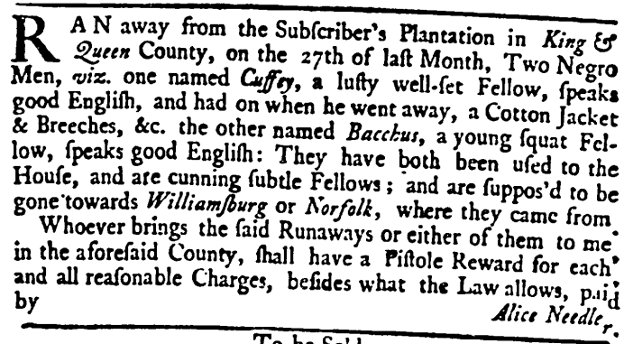
On what might otherwise have been an ordinary day in King and Queen County, in February of 1745, two enslaved men named Bacchus and Cuffey were able to escape from the plantation where they were forced to serve. With drab, cloudy skies and temperatures averaging around freezing, Virginia winters are not as mild as the colony’s southern location might suggest. For Cuffey and Bacchus, this meant navigating through cold and generally harsh winter conditions.[1]
In the advertisement Cuffey is described as a “lusty well-set Fellow” who also spoke “good English.” Had he been born in the colonies he would have been raised with English as his first language, so the fact that he was judged to speak “good English” suggests he was an African who had been transported to Virginia, where he had learned this new language. The name Cuffee, spelled different ways, is an Anglicization of the Akan name Kofi, a day-name indicating the bearer had been born on a Friday. It is quite possible that this man had retained the name he had held in the Akan-speaking region of the Gold Coast, in what is today southern Ghana.[2] Cuffey was said to be “used to the House,” meaning that he worked as a domestic servant rather than out in the fields. He was also described as a “cunning subtle Fellow.” This negative language suggests Cuffee’s enslavers viewed him as deceitful; more likely Cuffe was simply intelligent and capable, qualities that challenged enslavers. Cuffey was also described as “well-set” and “lusty,” words used to indicate a visibly healthy stature.
Cuffey did not leave alone. Another enslaved servant named Bacchus left alongside Cuffey, and it appears that the two had plotted their escape together. Bacchus is described as a “young squat Fellow,” who was also “used in the House” as a domestic worker. Bacchus was identified in the advertisement as being shorter and younger than Cuffey. Alice Needler, their enslaver and the author of the advertisement, noted that Bacchus also spoke “good English,” suggesting that he may have been also West African by birth. Both men would have spoken English with an accent. Did Needler perhaps think that the two continued to communicate in a West African language that she could not understand?
Because both Bacchus and Cuffey worked as domestic servants, they were used to being in close proximity to White people. Inside Needler’s home they would have worked as footmen or waiters, helping dress and undress White men, undertake a variety of domestic chores, and perhaps care for horses used by the enslavers. The nature of their work meant that it was important for both men to be able to communicate clearly with White men and women. They were expected to take direct orders and confirm that they understood. Did that, and their ability to function in White society, speaking good English, help render them “cunning” and “subtle” in her eyes? It is ironic that English language skills were required of them to do their work, and yet their linguistic abilities and their experience of household work and interaction with White people were also tools they might use to make good their escape. Perhaps Needler felt that all “well-spoken” house servants were inherently “cunning.”[3]
In many cases enslavers imposed new names on newly arrived West Africans, deliberately erasing their past identities, and it seems unlikely that Needler or another White Virginian would have renamed him with an African name. In Cuffey’s case it appears that he had been able to hold on to his original African name, quite likely given to him by his parents. What did keeping this name mean to him? Did it enable him to retain a sense of African identity, and connection to the family and community from which he had been so violently taken? Or did the continued use of this name by White enslavers who controlled him mean that the name now felt corrupted and abused? We cannot know. It is clear, however, that if Bacchus had also been born in Africa, he no longer had his original name. Bacchus was a name given to him by Needler or another White person and it reflected a long-standing tradition in naming enslaved people. Bacchus was the god of wine from Greco-Roman myth, and it was one of many classical names commonly given to enslaved Africans by their White enslavers. These names were often used ironically or to demean the enslaved person. The god Bacchus was charming and fun, yet was also responsible for bacchanalia, the riotous partying of his followers. It implied a person with too little self-control, and perhaps in this case was meant to reinforce the stereotype of this enslaved man being sly and cunning.
Although not much is known about the plantation they worked on, it was likely a tobacco plantation given its location on the middle peninsula in King and Queen County, between the Rappahannock and York rivers.[4] The advertisement was published at least three times during March of 1745 by Alice Needler, who was around forty at the time of Bacchus and Cuffey’s escape. Her husband, Benjamin Needler had died four years earlier, leaving the widowed woman to manage the affairs of the plantation.[5] The advertisement does not indicate that either Bacchus or Cuffey bore scars from whipping, but this does not necessarily mean that they had not suffered violence. It was not unusual for women to enact physical violence against enslaved people, but there were also instances of women disallowing such actions.
As for where Bacchus and Cuffey might be heading, Needler claims that they are “suppos’d to be gone towards Williamsburg or Norfolk,” which are to the southeast of King and Queen County. If Norfolk was indeed their destination, perhaps the two men hoped to use the port to get out of Virginia altogether. The absence of archival clues means we cannot know whether or not Bacchus and Cuffey made a safe escape to Williamsburg, Norfolk, or beyond. Perhaps they were recaptured and returned to Needler, or maybe they were able to remain free, at least for a while. The fact that Needler kept advertising for a month indicates that they were free for at least that long. We cannot know whether they either were returned to her, or she tired of paying for the advertisements with no success and these two African men found freedom.
View References
[1] The average temperature was about 37°, as recorded in Thomas Jefferson’s weather observations from February 1788, 1789, and 1790. Though these are several decades after 1745, it might be inferred that the winter weather was similar at the time Bacchus and Cuffey escaped. “Daily Observation Records,” Jefferson Weather Records, https://jefferson-weather-records.org/documents [accessed May 19, 2026].
[2] David DeCamp, “African Day Names in Jamaica,” Language, 43 (1967), 139–149.
[3] “House Servants,” Encyclopedia Virginia. https://encyclopediavirginia.org/entries/enslaved-house-servants/ [accessed May 19, 2026].
[4] “County History,” King and Queen Museum. https://www.kingandqueenmuseum.org/county-history/ [accessed May 19, 2026].
[5]“Journals of the Council of Virginia in Executive Sessions, 1737-1763,” Virginia Magazine of History and Biography, October 1907, Vol. XV. No. 2, page 129, https://archive.org/details/sim_virginia-magazine-of-history-and-biography_1907-10_15_2/; “Needler, Benjamin,” Encyclopedia of Virginia biography, ed. Lyon Gardiner Tyler, Vol. 1 (New York: Lewis Historical Publishing Company, 1915) https://archive.org/details/encyclopediaofvi01tyleuoft/.