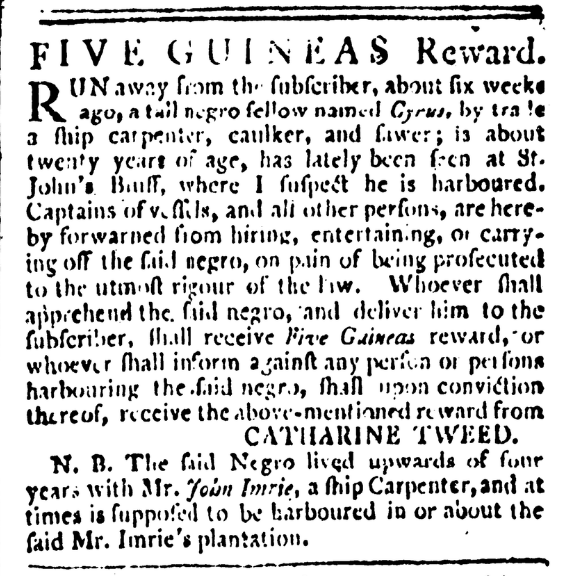
In 1783, among the live oak canopies that spread across the St. Augustine sky, and the wild mangrove bushes that populated the salt marshes, news began spreading among colonists that British Florida had been pawned to the Spanish. These rumors and the resulting chaos helped enable Cyrus to slip away unnoticed. In the first moments after his departure and then in the days that followed, Cyrus leveraged the shifting imperial powers of the Southern coastal border lands, utilizing his boatmaking abilities and his ties within the local community to leave Catherine Tweed , his enslaver. His escape demonstrates how enslaved people used their expertise and the disorder occurring during and after the American Revolution to secure their own liberty. These factors gave enslaved people leverage that disrupted slaveholders’ control, showing that power was not always one-sided.
Cyrus escaped in early April of 1783, directly after the announcement that Florida was to be ceded from the British crown to the Spanish. The Revolutionary War was ending, and Britain was withdrawing troops from the newly established United States. St. Augustine was in a unique position, as it had been under Spanish rule until ceded to the British in 1763. Then, during the War for Independence, the region became a refuge for many British sympathizers fleeing Patriot-controlled plantation colonies in Georgia, the Carolinas, and beyond. According to the terms of the Treaty of Paris, which ended the war and guaranteed American independence, the British agreed to remove British inhabitants within 18 months, which helped create the turmoil that Cyrus leveraged.[1]
Tweed’s advertisement focuses on Cyrus’s trades in ship-building and carpentry rather than a physical description of him or his clothing. Only a minority of enslaved people in Florida were skilled craftsmen; about 20% of the enslaved population were recorded as such skills, and Cyrus had likely been trained when he was enslaved by a ship carpenter named John Imrie a few years prior. Catherine mentions that Cyrus was tall and about twenty years of age, and so he was likely born sometime around 1763, at the time that Florida had been transferred from Spain to Britain. While the advertisement does not mention any language he speaks, there was a pidgin language that enslaved people developed in regions like Florida reflecting the intersection of Spanish, English, French, Mandingo, and Fulani and other West African languages. Cyrus likely spoke or was at least familiar with this hybrid language. This ability to communicate across racial and ethnic lines likely strengthened the enslaved community and Cyrus’s network for escape.[2]
Before escaping, Cyrus worked hard to establish community ties and a trade, and these gave him valuable tools for his escape. The advertisement mentions that Cyrus worked on John Imrie’s plantation for about four years. According to compensation claims he made to the British government, John had enslaved at least fourteen people at one point, and these people worked on his tar and turpentine plantation, cultivating vital products for his shipbuilding business. Others, likely including Cyrus, assisted John in building or repairing boats and ships. Catherine bought Cyrus from John, probably in around 1782. She was a widow and likely tried to capitalize on Cyrus’s boatmaking abilities to support her family in the absence of her British husband, who had been killed by the Patriots. It was not unusual for widows and single women to own skilled enslaved men, and then rent them out to people who paid these women for the enslaved men’s skilled work. Catherine emphasized Cyrus’s skills in the advertisement, likely because she knew that they provided him with the best way of making a living as a free man, and perhaps even finding work as a ship carpenter on a vessel sailing away from Florida to freedom. It is possible that Cyrus sought to return to John Imrie’s plantation, perhaps because of close connections with other enslaved people on or near the plantation: he may even have had a parent, or a wife or partner there.[3]
As Cyrus escaped into the Floridian wilderness, he took advantage of the territorial shifts and resulting colonial disorder post-Revolutionary War, which likely improved his chances of survival. The cession of Florida to Spain was set to drastically change Cyrus and other freedom seekers’ lives. Spanish colonies developed social systems that were very different from British colonies, and often provided room for freed people to more fully integrate into society. This meant that the shifting borderlands gave at least a little power back to enslaved people, as there was a greater chance of emancipation. In addition, when this cession was announced a few days before Cyrus’s escape, chaos ensued. British troops stationed there mutinied, and theft of property, enslaved people, and livestock resulted. As people either plundered or packed their belongings, Cyrus strategically blended into the background as the world lost control around him.[4]
After discovering that Cyrus was gone, Catherine specifically includes in the advertisement that she suspected him to be harbored on Imrie’s plantation. She was careful not to directly accuse Imrie of harboring a runaway, and Catherine may have meant that she thought Cyrus had returned to the enslaved community. But it was possible that Imrie might welcome Cyrus back, and seek to take advantage of his skilled labor. The 1783 Spanish Census of Florida revealed that John had eight enslaved people on his plantation and one in “Providence,” who he would bring back to his plantation if John was permitted to remain in Florida. This may refer to a fugitive who John had secreted away from his plantation, although we cannot be sure of this. Perhaps this was Cyrus, returning to a loved one, or preferring working for John than for Catherine. It is also possible that Catherine was preparing to leave Florida, taking Cyrus and any other enslaved people she owned with her, and perhaps Cyrus escaped in order to remain in Florida. Thus there were many possible explanations for Cyrus choosing this time to escape, and perhaps heading for John’s plantation and shipbuilding operation. Many enslavers emigrated from Florida in or shortly after 1783, and in fact John himself would leave two years later and return to his native Scotland. Some enslavers left their bondsmen and women behind, while in other cases enslaved people like Cyrus took advantage of the situation and escaped. By the end of the British evacuation 42% of enslaved people were unaccounted for. The Black Seminole population also increased at this time, another emerging power in Florida, demonstrating how enslaved people utilized the shifting control of the borderlands to escape slavery and find their own lives among the local Indigenous community. Perhaps Cyrus was one of these people, away from bondage, finding home within the native or maroon communities of Florida.[5]
The end of the American War for Independence brought a change of imperial government in eastern Florida. For an enslaved man like Cyrus the political changes and resulting social chaos, along with his own skills and his local knowledge and community ties, gave him a certain advantage over Catherine in his escape. This story complicates the traditional power dynamic between enslaved people and enslavers, revealing that at times of political and social stress enslaved individuals could exercise greater agency, strategy, and power than was usual. Cyrus’s journey serves as a powerful reminder that enslaved individuals often found cracks within systems of their oppression, using those small points of leverage to reclaim their agency and chart their own path toward freedom and kin.
View References
[1] This story builds from ideas presented in Kathleen DuVal, Independence Lost: Lives on the Edge of the American Revolution (New York: Knopf, 2015). This piece frames the Revolutionary War and shifting powers as a key factor in self-emancipation journeys in the border lands. See also Carole Watterson Troxler, “Loyalist Refugees and the British Evacuation of East Florida, 1783–1785,” Florida Historical Quarterly 60, no. 1 (1981), 2-3.
[2] J. Leitch Wright Jr., “Blacks in British East Florida,” The Florida Historical Quarterly 54, no. 4 (April 1976), 429, 427.
[3] Wilbur Henry Siebert, Loyalists in East Florida, 1774–1785, vol. 2 (1929), 163. John arrived in Florida in 1778, and Catherine mentions that Cyrus had been enslaved by John for four years. Marcelle R. Wilson, “Loyalists: Economic, Gendered, and Racial Minorities Acting Politically for King and Country,” (PhD diss., West Virginia University, 2003), 93-94. https://researchrepository.wvu.edu/cgi/viewcontent.cgi?article=11021&context=etd [accessed May 7, 2026].
[4] Larry Eugene Rivers, Slavery in Florida: Territorial Days to Emancipation (Gainesville: University Press of Florida, 2009), 12. Troxler, “Loyalist Refugees…”, 7.
[5] Silas Emmett Lucas Jr., ed., “The 1783 Spanish Census of Florida,” Georgia Genealogical Magazine 39 (Winter 1971), 73; Siebert, Loyalists in East Florida, Vol 2, 163; Patrick Riordan, “Finding Freedom in Florida: Native Peoples, African Americans, and Colonists, 1670–1816,” The Florida Historical Quarterly 75, no. 1 (Summer 1996), 37; Wright, “Blacks in British East Florida,” 441.