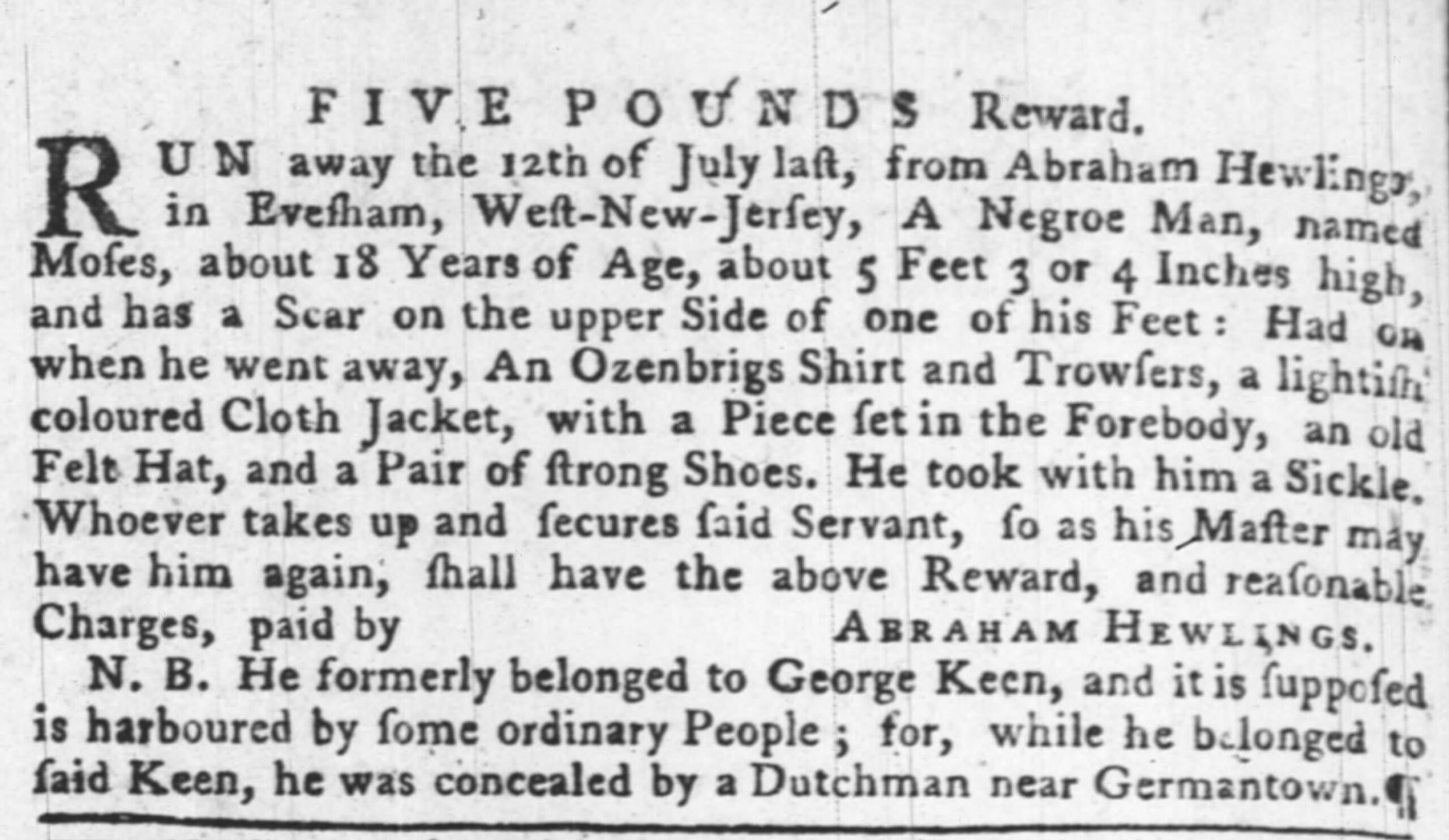
Amidst the economic and social disruptions of the French and Indian War and its immediate aftermath, Abraham Hewlings was dealing with his own crisis. On July 12th, 1763, an enslaved man named Moses escaped from the Hewlings’ residence. Abraham, desperate to get his enslaved servant back under his control and conscious of Moses’ previous escape attempt, took out an advertisement in the Pennsylvania Gazette, which appeared nearly three months after Moses had eloped. Often enslavers waited for a while before advertising, hoping that the freedom seeker might return of his own accord, but this seemed unlikely after such a long absence. The advertisement gave a quite basic description of Moses’ appearance, including a small scar on his foot. Abraham offered a reward of five pounds for his recapture.[1] By this point, Moses had been on the run for two and a half months.
Moses’ story can be seen from two different perspectives: that of the enslaved and their culture of resistance, and that of the White population who struggled to subordinate the enslaved population, amidst their fears of potential rebellion. Moses’ escape and theft of a tool that might be utilized as a weapon connects him to the larger history of Black rebellion during the colonial period. The advertisement Abraham published illustrates both White fear of Black rebellion, and a related fear of other White men and women aiding and sheltering enslaved people who had escaped, undermining the entire system of slavery.
A “culture of resistance” refers both to the open and the hidden actions of enslaved people who sought to disrupt and resist enslavement. Active resistance, like truancy, running away, and violent rebellion held the promise of freedom, even if only for a while. Hidden acts, like breaking or stealing tools and other items belonging to enslavers allowed enslaved people to avoid using direct aggression in their resistance, and often to avoid punishment. Open and hidden resistance had existed since the enslavement of Indigenous and African people in the early seventeenth century.
Slavery expanded rapidly in eighteenth-century New Jersey, with the number of enslaved people rising from an estimated 4,000 in 1737 to over 12,000 by 1800. In some areas, such as Bergen County, enslaved people constituted one-fifth of the population.[2] As the Black population increased, so too did resistance, some of it violent. Slave revolts in nearby New York City in 1712 and 1741 may have helped encourage an attempted rebellion in Somerset County, New Jersey, in 1734, and in 1752 an enslaved man was executed for murdering his enslaver, Jacob Van Neste, with an axe.[3] Enslavers in New Jersey were all too aware of the danger of violent slave resistance, and presumably Abraham Hewlings was no different.
The image of an enslaved man murdering his master with his own tool may have haunted Abraham as he wrote his advertisement. Although a sickle was an agricultural tool, it was an unusual thing for a freedom seeker to take: if he or she secured work on another farm, tools would have been provided. Abraham almost certainly believed that Moses had taken the sickle as a weapon, and a deadly one at that.
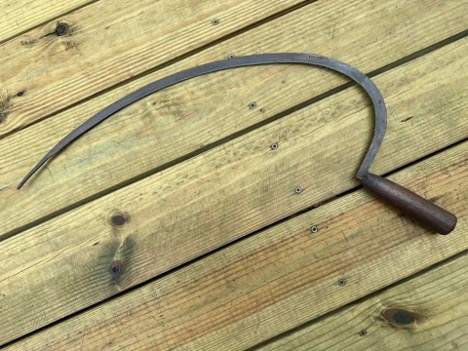
A sickle has a curved blade, typically used to harvest grain crops. Its sharp edge also make it an effective weapon, and for many centuries rural rebels in Europe had armed themselves with sickles and scythes, the tools that were closest to weapons. Moses may have stolen the sickle to disrupt Abraham’s harvest, which would have been in its peak season during mid-July. But it seems more likely that Moses viewed the sickle as a weapon with which to defend himself while on the run.
Moses’s shirt and pants were made of ozenbrig, a common fabric for slave clothing.[4] His hat, jacket, and shoes appeared equally ordinary, and were the common garments for agricultural workers, whether enslaved or free.[5] If this was the only clothing that Moses owned, he may well have tried to exchange it or gain other items of clothing, in order to change and disguise his appearance. At least his shoes meant that the tell-tale scar on his foot was not immediately visible.
Evesham, located in Burlington County, New Jersey, was settled by Quakers in the late 1680s.[6] In nearby Philadelphia, the middle parts of the eighteenth century saw the peak of the importation of enslaved Africans.[7] Advertisements in the Philadelphia newspapers reveal a growing number of escapes, and of course many enslaved people eloped but were not the subject of advertisements, so the number of freedom seekers was much higher than the number of advertisements might suggest.[8]Moses, having hidden in a suburb of Philadelphia in the past, would have been aware of the heightened surveillance of Black people and the risks involved in multiple escape attempts.
Perhaps Moses sought refuge with Quakers, who by 1738 comprised over half of Burlington County’s population.[9] The yearly gathering of the Society of Friends alternated between Philadelphia and Burlington County until 1764, making Burlington County a significant location in Quaker society.[10] Hewlings would have been aware of the growing anti-slavery sentiment among Quakers, although at this time many continued to hold enslaved people. In 1688, the Germantown Quaker Meeting drafted the first anti-slavery resolution in colonial history, arguing that the institution went against the pillars of their religious doctrine.[11] By 1755, the Yearly Meeting had accepted a motion from John Woolman, a prominent Friends preacher, to no longer allow members to engage in the purchasing or sale of enslaved people.[12] Three years later, the meeting voted to remove any members still owning enslaved men, women, and children.[13]
In his advertisement Abraham accused “ordinary people” of harboring Moses, suggesting that he suspected that non-slaveholding White people, perhaps including Quakers, were more likely to assist a freedom seeker.[14] Abraham voiced this suspicion in his advertisement as a warning to other enslavers: Do not trust your neighbors. Perhaps, too, he was warning those who harbored freedom seekers that they would face legal challenges, and perhaps be forced to pay a cost for their actions. Clearly, Moses had made connections in Germantown in the past. It is unlikely that the Dutchman linked to Moses’ past escape attempt was a Quaker, but to enslavers like Abraham, anyone living in proximity to or associated with the Society of Friends was under suspicion.
It is not clear if Abraham’s advertisement in the Pennsylvania Gazette was successful. We do not know whether Moses escaped to Germantown again, or if he went somewhere else. We can only hope that this brave teenager found freedom. We do know, however, that Abraham held two people in bondage ten years later.[15] While slavery persisted in New Jersey well into the second half of the nineteenth century, so too did the culture of resistance among the enslaved residing there. Through his escape, the clothing he wore, and the tool that he took, Moses contributed to that culture, exposing the underlying fear of loss of control that his enslaver harbored along the way. As the young man made his way carrying a sharpened sickle, we can imagine the full promise of freedom, and the threat to enslavers who sought to stamp it out.
View References
[1] “FIVE POUNDS…,” The Pennsylvania Gazette (Philadelphia, Pennsylvania), September 29, 1763, 3.
[2] Rann Miller, “Slavery and Rebellion in Eighteenth Century New Jersey,” Black Perspectives, (27 March, 2023), https://www.aaihs.org/slavery-and-rebellion-in-eighteenth-century-new-jersey/ [accessed May 4, 2026].
[3] Abraham Messler, First Things in Old Somerset: A Collection of Articles Relating to Somerset County, NJ. (Somerville, New Jersey: The Somerville Publishing Company Steam Power Printing House, 1899), 57. See also Graham Russell Hodges, Root and Branch: African Americans in New York and East Jersey, 1613-1863 (Chapel Hill: University of North Carolina Press, 1999), 69-138, and Miller, “Slavery and Rebellion.”
[4]Shane White, Shane and Graham White. “Slave Clothing and African-American Culture in the Eighteenth and Nineteenth Centuries,” Past & Present, no. 148 (1995), 143.
[5] Ibid., 159.
[6]John E. Pomfret, “West New Jersey: A Quaker Society 1675-1775,” The William and Mary Quarterly 8, no. 4 (1951), 494.
[7] Maurice Jackson, Let This Voice Be Heard: Anthony Benezet, Father of Atlantic Abolitionism (Philadelphia: University of Pennsylvania Press, 2009), 14.
[8]See Billy G. Smith and Richard Wojtowicz, Blacks Who Stole Themselves: Advertisements for Runaways in the Pennsylvania Gazette, 1728-1790 (Philadelpia: University of Pennsylvania Press, 1989).
[9] Pomfret, “West New Jersey,” 495.
[10] Ibid., 502.
[11] “Quaker Protest Against Slavery in the New World, Germantown (Pa.) 1688.” Philadelphia Yearly Meeting of the Religious Society of Friends, 1688, TriCollege Libraries Digital Collections,https://digitalcollections.tricolib.brynmawr.edu/object/hc135384 [accessed May 18, 2026].
[12] Peter Silver, Our Savage Neighbors: How Indian War Transformed Early America (New York: W.W. Norton & Company, 2008), 28.
[13]Maurice Jackson, “Chronology of Atlantic Abolitionism,” Let This Voice Be Heard: Anthony Benezet, Father of Atlantic Abolitionism (Philadelphia: University of Pennsylvania Press, 2009), 245.
[14] “FIVE POUNDS…,” The Pennsylvania Gazette (Philadelphia, Pennsylvania), September 29, 1763, 3.
[15] Ratables, Burlington County September 1773, State of New Jersey Public Records Office, https://www.nj.gov/state/darm/WebCatalogPDF/SAS00001_Tax_Ratables/Burlington_County/Book175_BurlingtonBurlingtonCitySeptember1773.pdf [accessed May 18, 2026].