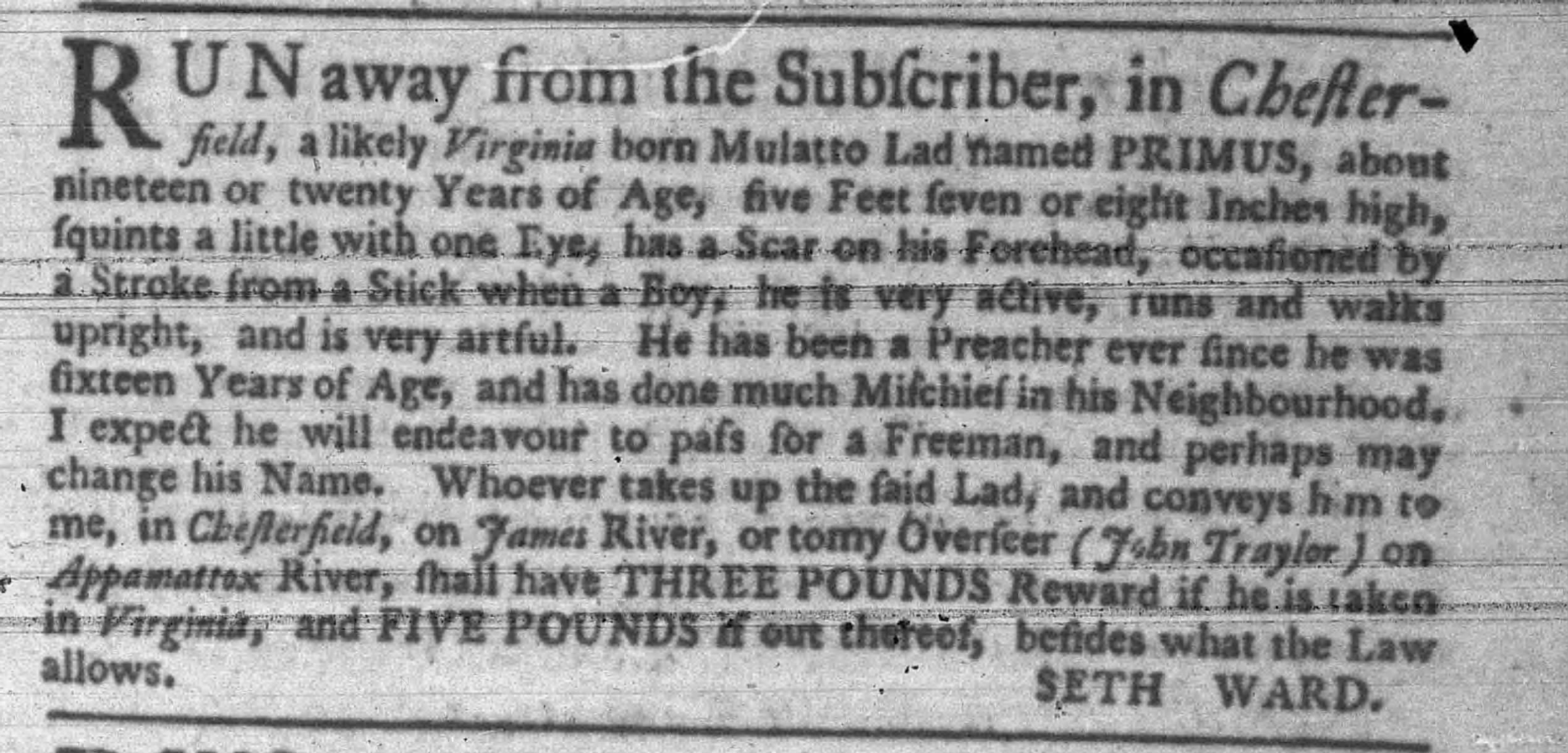
On February 27, 1772, the Virginia Gazette published an advertisement describing a “Mulatto lad named Primus,” approximately twenty years old, who had run away from his enslaver in Chesterfield. Seth Ward was a wealthy planter who had inherited two plantations from his father. In Ward’s description, Primus stood about five feet eight inches tall, with a distinctive scar on his forehead, a mark made by a stick during his childhood. Yet despite the possibility that this was a mark of violence from his youth, Primus didn’t walk like a man who had been broken. He moved with an “upright” gait and an “active” energy. Moreover, Primus had served as a preacher and done “much mischief” since the age of sixteen.[1]
We do not know what Ward meant by “mischief.” In some advertisements this word was used by enslavers to suggest cunning and an ability to cause problems. But Ward linked the word “mischief” to Primus’s preaching. Perhaps Ward was concerned that by spreading Christian doctrines among enslaved people, Primus may have been encouraging the enslaved to think more highly of themselves, just as he did when he walked upright and straight. It makes sense that Ward’s advertisement would mention that an enslaved man had experience as a preacher, since that detail could help identify him. Primus offers an example of how enslaved people used evangelical Christianity in Revolutionary-era Virginia to increase their sense of self-worth, their status, and perhaps even to leverage their freedom.[2]
Primus preached in the era of the First Great Awakening. The evangelical “New Lights” in the Great Awakening movement emphasized the spiritual equality of all souls before God, and the authority of inner conviction over institutional hierarchy. This had potentially radical implications: enslaved people did not need educated, professionally trained White ministers, nor did they need the formal institutions of Virginia’s White Anglican church. Instead, a preacher could gather believers around him, and they could learn and worship together, in a field, in slave quarters, or in any space available to them. While enslavers viewed the Bible as supporting slavery and mandating that servants and the enslaved should obey their masters, evangelical Christianity could instead suggest grounds for disobedience. Theologically, some evangelicals s maintained that any individual could attain immediate salvation and that all people, including the enslavedm should “be treated well and instructed in Christianity.” While enslaved Black people were segregated within and allowed no formal roles in White churches, when they formed their own congregations and churches, Black preachers assumed leadership roles. Moreover, in conversations and disputes, some White Baptists commended the words of Blacks as worthy of White male attention. As a result, Baptists spread rapidly and converted many Black people across the colonies. In the 1760s and 1770s, evangelical efforts among enslaved people gained further momentum, as reports increasingly linked runaway slaves with Baptist affiliation. It appears very likely that Primus was influenced by the currents of the Great Awakening and became an evangelical preacher. For Primus, a young enslaved man described as “artful” and already preaching at sixteen, the ideas of the Great Awakening may have given him not just religious meaning but a way to see himself as more than the property of another man.[3]
However, while Primus’s religious background may have motivated his escape, it may also have provided the practical resources necessary to pursue his freedom. One important quality for someone attempting to “pass as a free man” was literacy, which enabled forgery of travel papers, facilitated navigation, and allowed freedom seekers to move through society without raising suspicion. Primus’s role as a preacher and the “mischief” he had done suggest that he may have been literate. Some enslaved preachers were illiterate, committing sections of the Bible to memory and preaching and ministering through an oral rather than written culture of Christianity. But direct engagement with scripture is a fundamental part of evangelical theology, and the ability to read, interpret, and teach from the Bible was a valuable skill for an aspiring minister. Moreover, some evangelicals argued that religious training and education could place African and European Americans on a more equal footing, since new birth in Christ applied to both alike, offering equality before God. Consequently some White people influenced by evangelical beliefs put the education of Black people into practice. Samuel Davies, a Presbyterian minister, promoted African American conversion in part hoping it would support educational efforts in Virginia. Methodist leader John Wesley also contributed to these efforts, sending books from England to Davies on at least one occasion for distribution among poor Black and White communities. These efforts met with some success, as Davies was “impressed with some slaves’ ability to read.” These developments suggest that if Primus was indeed literate, this had been shaped, at least in part, by the evangelical religious environment in which he lived.[4]
Another essential asset for someone attempting to “pass as a free man” was having social connections to secure shelter and documentation. Primus’s role as a preacher likely provided him with extensive social connections that he needed to “pass as a freeman.” In the middle to late eighteenth century, Black enslaved people and the poorer sections of the White community sometimes associated closely and openly. Underground networks of Black communities also provided vital support to freedom seekers. Given that Primus had already done “much mischief in his neighbourhood,” and preachers addressed large and diverse audiences, it is likely that he had contact with a network of free Black and perhaps even poor White people who potentially could offer shelter or provide signed documentation. Primus’s religious skill may also have worked to his advantage, as there were rare instances in which religious Whites purchased the freedom of enslaved preachers. Although Primus’s freedom was apparently never purchased as far as we know, it is plausible that religious Whites may have assisted him financially or otherwise.[5]
Ward’s decision to place advertisements in both Williamsburg papers is particularly revealing. Williamsburg lay roughly sixty miles east of Chesterfield. As the capitol of the colony, Williamsburg had by the 1770s emerged as an important place of Black Baptist activity. Williamsburg also had a notably large Black population.. While there is no direct evidence that Primus was connected to this community, it is plausible that Seth Ward recognized Williamsburg as a destination where an enslaved preacher like Primus could find both anonymity and support. Also, the Virginia Gazette was distributed and read all over the colony, so by advertising in that newspaper Ward could hope to alert White people all across the region.[6]
Taken together, the evidence suggests that evangelical religion not only provided Primus with spiritual values and purpose but also helped inform his escape, offering practical resources that helped make his bid for freedom possible. As for Primus’s fate, the historical record is silent. Yet this silence does not necessarily indicate failure. Indeed, the absence of further records under the name “Primus” may itself be suggestive. Runaway advertisements were designed to recover enslaved individuals, and when they disappear from the archival trace, it could mean either that they had been recaptured or that they had found freedom. Primus may have found a place to continue his religious work under a different identity.
View References
[1] “RUN away from the Subscriber, in Chesterfield,” Virginia Gazette (Purdie & Dixon) (Williamsburg), February 27, 1772, 3; Ward Family (Concluded),” The William and Mary College Quarterly Historical Magazine 27, no. 4 (April 1919): 260-261, 281.
[2] The population of colonial Virginia in 1770 is estimated at approximately 447,016. Of this total, around 180,500 were Black inhabitants, constituting roughly 40 percent of the population. By contrast, Baptists of all races likely made up only about 10 percent of Virginians by 1772, with Black preachers like Primus representing an even smaller proportion. See Historical Statistics of the United States: Colonial Times to 1957 (U.S. Government Printing Office, 1960), Series z1-19, “Estimated Population of American Colonies: 1610-1780,” 1168; Philip D. Morgan, Slave Counterpoint: Black Culture in the Eighteenth-Century Chesapeake Lowcountry (Chapel Hill: University of North Carolina Press, 1998), 81. Rhys Isaac, The Transformation of Virginia: 1740-1790 (Chapel Hill: University of North Carolina Press, 1982), 173.
[3] Thomas S. Kidd, The Great Awakening: A Brief History with Documents (Boston: Bedford St Martin’s, 2008), 18; Thomas S. Kidd, The Great Awakening: The Roots of Evangelical Christianity in Colonial America (New Haven: Yale University Press, 2007), xv ; Kidd, The Great Awakening: A Brief History with Documents, 18, 19; Albert J. Raboteau, Slave Religion: The Invisible Institution in the Antebellum South (New York: Oxford University Press, 2004), 114-115; Morgan, Slave Counterpoint, 427.
[4] Kidd, The Great Awakening: The Roots of Evangelical Christianity in Colonial America, 123. 53, 239.
[5] Gerald W. Mullin, Flight and Rebellion: Slave Resistance in Eighteenth-Century Virginia (New York: Oxford University Press, 1972), 119; Enslaved Black preachers sometimes preach to hudreds of people in one occasion, as recorded in the writings of white Baptist Richard Dozier. See Morgan, Slave Counterpoint, 430, Morgan, Slave Counterpoint, 654.
[6] By 1775, approximately 52 percent of the town’s 1,880 residents were Black. See Linda Rowe, “Gowan Pamphlet: Baptist Preacher in Slavery and Freedom,” The Virginia Magazine of History and Biography 120, no. 1 (2012): 7.