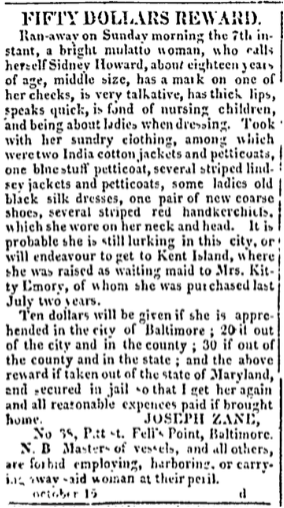
On Sunday morning, October 7th, 1810, Sidney Howard seized her freedom, stepping into Baltimore’s lively downtown port. Disguised in “ladies clothing” from her former enslaver with a red handkerchief wrapped around her head, Sidney, a light-skinned, or “bright” mulatto woman, slipped through the crowd, seeking refuge in the city that imprisoned her. In Fells Point, one of Baltimore’s main waterfront districts, Sidney was immersed in the city’s economic and social life, including a growing free population.[1] Amid the city’s trade and exchange of ideas, Sidney may have heard of avenues to escape; of people who could smuggle, hide, or help her. Then in October, she took her chance.
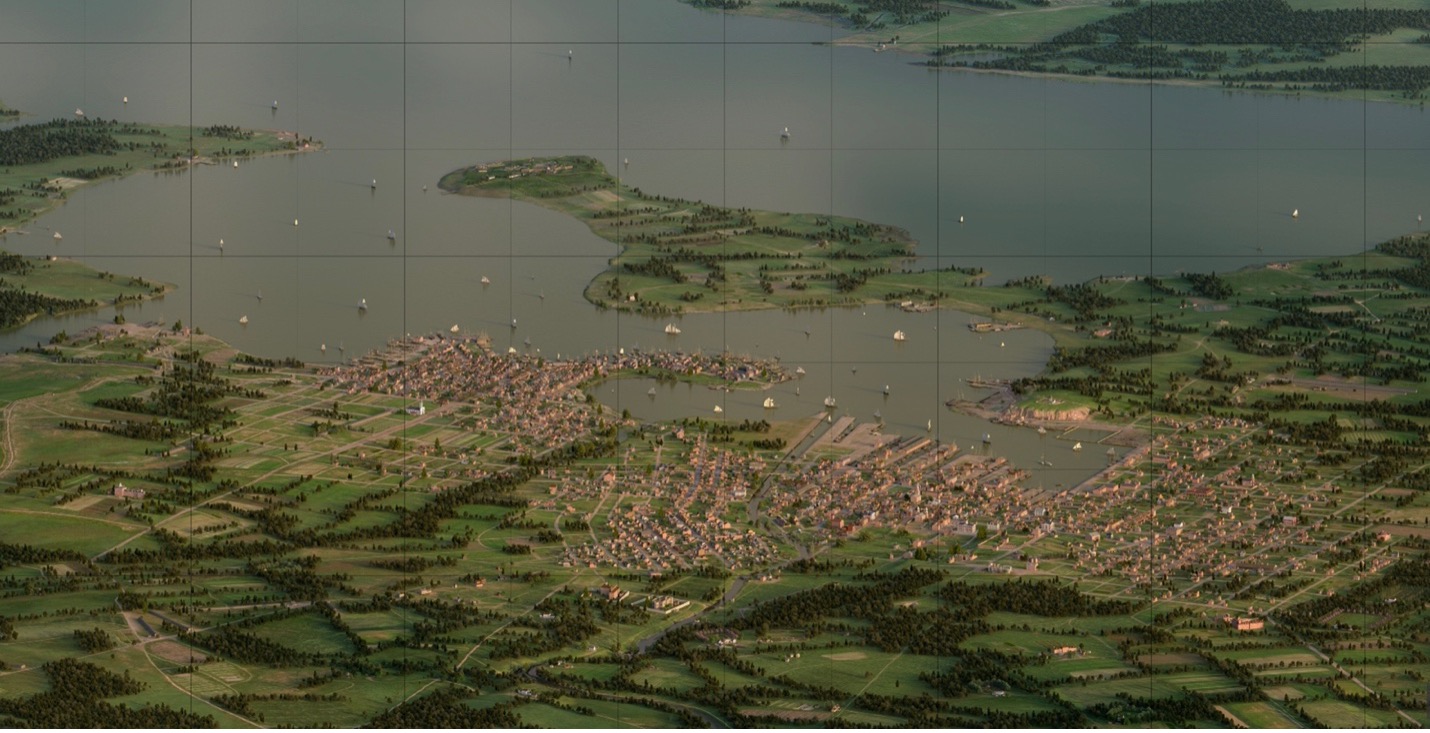
Sidney was “raised as a waiting maid” to Kitty Emory on Kent Island, which was about twenty-five miles south of Baltimore in Chesapeake Bay. The Emorys were wealthy planters and enslavers with deep roots in Kent Island.[2] Sidney would have done constant, tedious chores, all while being on call to her enslavers. She was responsible for domestic matters, such as cleaning, sewing, helping White women get dressed and undressed, and childcare. Through this work Sidney would have developed the skills necessary to navigate White spaces and society that aided her escape and perhaps then her passing as a free woman. However, the proximity to White enslavers made enslaved women and girls especially vulnerable to sexual predation.[3]
Given that after her sale to Joseph Zane, Sidney was required to nurse her enslaver’s child, the eighteen-year-old enslaved woman had already given birth to at least one child of her own. This suggests that she may have had a lover, perhaps even a family, or that she had been the victim of sexual violence. Sidney was, after all, mixed-race, her skin the visible byproduct of a system that routinely exploited enslaved women’s vulnerability.[4] In 1808, Sidney was sold to Joseph Zane: he was an oak cooper, a skilled craftsman making barrels for the storage of goods being transported in and out from Baltimore’s docks. Sidney was purchased, at least in part, to serve as a wet nurse for Zane’s bride, Eliza Hopkins.[5] Enslaved women’s bodies were commodified for their “capital” of milk to ease the burdens on White mothers. Sometimes enslaved women nursed their own and their enslavers’ children, but often the children of enslaved wet nurses were passed on to other enslaved women. It was not unusual for the children of enslaved wet nurses to suffer and even die without the care and attention of their own mothers. Separating mothers from their children left a deep psychological impact, alongside the strenuous work of nursing another’s baby multiple times a day at the expense of their body, all while navigating household tasks. White women enslavers manipulated motherhood, keeping enslaved women close, but maintaining racial barriers, stripping enslaved mothers of the ability to care for their own children. Zane asserts that Sidney was “fond of nursing children,” a distortion that is not merely a subtle reference to her experience as a wet nurse, but a manipulation to disguise Sidney’s maternal grief and anguish. Sidney had no choice but to care for the child of her enslaver, but her escape makes clear her refusal to be commodified.[6]
Zane’s advertisement provides evidence for Sidney’s continual resistance to objectification, offering glimpses of her character and individuality, grudgingly admitted by Zane. The phrase “calls herself” reflects Sidney’s resistance through her choice and use of a name. Zane used her chosen name, understanding it was what she would answer to. Unlike many enslaved people, Sidney Howard had a last name, a marker of identity, value, family, and recognition of being a full person.[7] Though the origins of this name are unknown, Sidney insisted that her enslaver acknowledge her on her own terms.
Sidney had been enslaved by Zane for two years; about the same time wet nurses cared for children.[8] After years of degrading work and facing an uncertain future—unaware of where she would be going next, to whom, and for what purpose—Sidney became a freedom seeker. The advertisement does not mention Sidney taking a child with her, raising the possibility that her own child had died. If so, this must have increased the resentment Sidney felt at having had to care for her enslaver’s child while being forced to neglect her own. Zane published nineteen advertisements between October and December 1810; Sidney managed to evade her enslaver for at least three months, and perhaps for longer: he may have tired of spending money on the notices and stopped publishing them. We do not know if she returned to Kent Island, or whether she tried to create a new life for herself in Baltimore or elsewhere. Despite dehumanizing commodification, by escaping with bright and good quality clothing, Sidney asserted her individuality and strength. Seizing the opportunities presented by the shifting social and political landscape, Sidney disguised herself as a free woman and emancipated herself.[9]
View References
[1] Charles E. Steffens, “Who Owns the Waterfront? Property Relations in Fell’s Point, Baltimore, 1783.” Urbanism Past & Present 8, no. 1 (15) (1983), 12–17; Entry for Joseph Zane in William Fry, The Baltimore directory for 1810 . . . [serial]; containing the names, occupations, and places of abode of the citizens (Baltimore: Dobbin and Fry, 1810), 196. In the late 18th and early 19th centuries, Baltimore emerged as a global commercial hub and immigration port. The growing demand for casual and seasonal labor diminished the appeal of slave ownership, as owners did not want to be financially responsible for slaves’ annual upkeep. As paternalism declined, slavery became more associated with the exploitation of individuals, both immigrants and freed slaves, rather than an established system. While slavery persisted, the city’s shifting economy created an environment conducive to a freed population. Barbara J. Fields, Slavery, and freedom on the middle ground: Maryland During the Nineteenth Century (New Haven: Yale University Press, 1985), 40-57.
[2] Thomas Emory (b. 1782 – d. 1842), MSA SC 5496-51322, Archives of Maryland: Biographical Series. (2012, February 28); Thomas Emory (1782-1842), MSA SC 3520-1305. (2012, February 28). https://msa.maryland.gov/msa/speccol/sc5400/sc5496/051300/051322/html/msa51322.html [accessed May 5, 2026].
[3] Leni Sorensen, Enslaved House Servants – Encyclopedia Virginia. Encyclopedia Virginia, (August 26, 2024), https://encyclopediavirginia.org/entries/enslaved-house-servants/ [accessed March 20, 2026]
[4] Stephanie Jones-Rogers, They Were Her Property: White Women as Slave Owners in the American South (New Haven: Yale University Press, 2020), 106-107; see also Hilde, Libra R. “Tuckey Buzzard Lay Me: Slavery, Sex, and White Fathers.” In Slavery, Fatherhood, and Paternal Duty in African American Communities over the Long Nineteenth Century (Chapel Hill: University of North Carolina Press, 2020).
[5] Michael A. Ports, Michael A. Baltimore County, Maryland, Marriage Licenses (Baltimore, Maryland: Published for Clearfield Company by Genealogical Publishing Company, 2013).
[6] Stephanie Jones-Rogers, They Were Her Property: White Women as Slave Owners in the American South (New Haven: Yale University Press, 2020), 105-109, 121.
[7] Antonio T. Bly, “‘Indubitable signs’: reading silence as text in New England runaway slave advertisements.” Slavery and Abolition 42, no 2. (2020), 240–268.
[8] Emily West & R.J. Knight, “Mothers’ Milk: Slavery, Wet-Nursing, and Black and White women in the Antebellum South,” The Journal of Southern History 83, no. 1 (February 2017), 37–68.
[9] Damian Alan Pargas, Fugitive Slaves and Spaces of Freedom in North America (Gainesville: University Press of Florida, 2018).