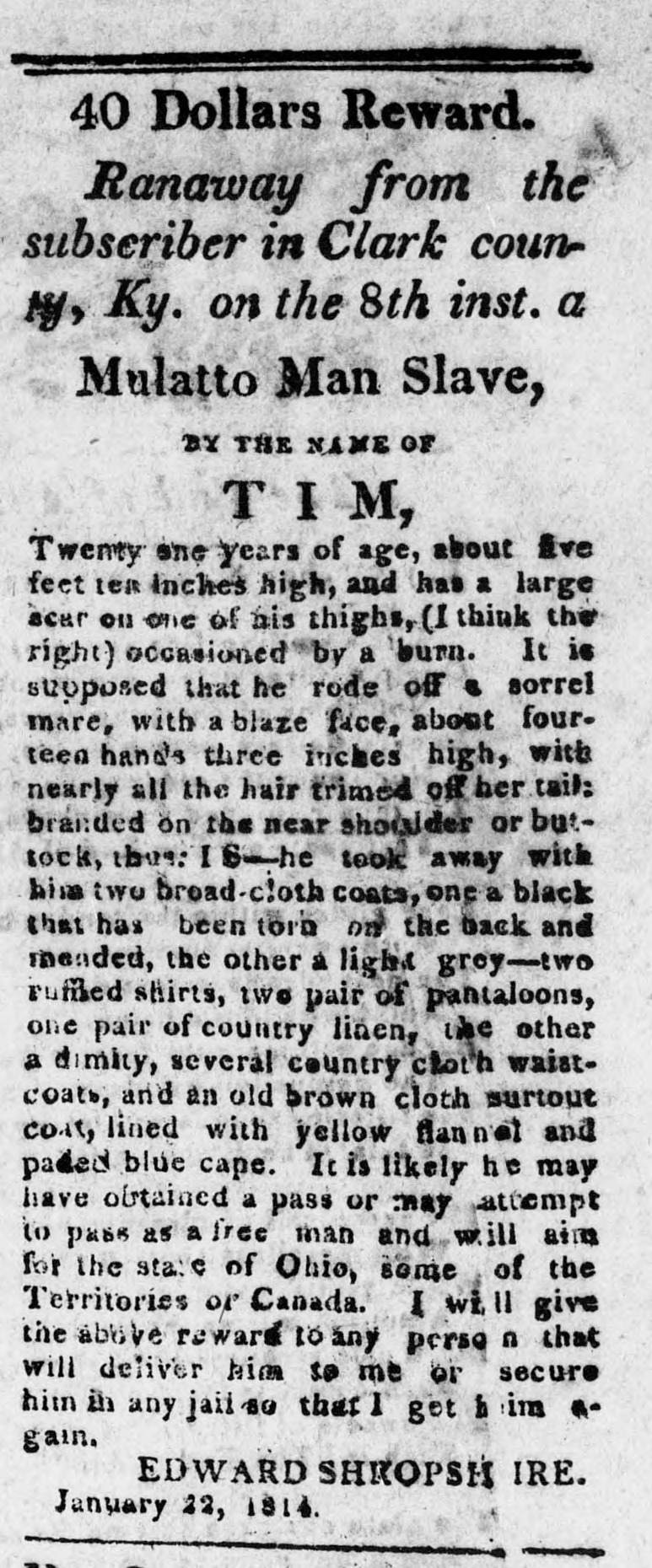
On a crisp January day in 1814, a young man paused beside a mare with a cropped tail, perhaps lightly stroking the blaze down the horse’s face to steady any unease. Moments later, viewed from some nearby height, an observer might have noticed a copper-colored blur dashing across the landscape of Clark County, Kentucky, as the pair began to move. The young man carried a pack with him. Inside were various clothing items, stitched, mended, and well-worn; two coats, two shirts, two pairs of pants, several waistcoats, and a surtout overcoat, all various colors and materials. On horseback, probably traveling as fast as he could, he headed north toward the Ohio River.[1]
The young man is known only to us as “Tim,” a “Mulatto Man Slave…twenty-one years of age.” He escaped from his Kentucky enslaver, Edward Shropshire, quite possibly aiming for freedom somewhere in “the state of Ohio, [or] some of the Territories or Canada.” His enslaver also noted the “large scar on one of his thighs…occasioned by a burn.” Although it is not possible to know with certainty what caused the burn and subsequent scar on Tim’s thigh, it could have been a result of the brutality and violence of enslavement, although given its location it was more likely the result of an accident on the plantation where he grew up and then worked. By escaping Tim unequivocally defied his status as property—taking another piece of “property” with him—rejecting the authority of plantation owners as he advanced north.[2]
The vast lands west of the Appalachian Mountains were of great significance in the early nineteenth century. As he navigated this space, Tim straddled not only his mare, but two periods of time, as the Age of Revolutions in North America came to a close, and a new, equally harsh period of colonial violence evolved across the Northwest Territory after the War of 1812. Kentucky occupied a complicated space in the western “frontier” region. In 1798, when Tim was likely just 5 years old, Kentucky adopted its first slave code, which mandated that enslaved people carry certain forms of documentation when traveling. Tim came of age in a state that increasingly restricted and criminalized the mobility of enslaved people. Clark County, more specifically, formed part of the Bluegrass Region of Kentucky. Cultivation of tobacco and hemp was popular throughout these areas, and the labor required was often performed by enslaved children. Perhaps Tim worked in these fields as a young boy, until he could work a more physically intensive job as an agricultural laborer or rancher, or even take on a more specialized role like a groom or stable hand, potentially granting him access to the horse that aided his escape. Regardless of the labor he performed, the rugged and hilly Kentucky terrain and increasing restriction on the movement of enslaved people could have been motivators to abscond.[3]
While Tim’s precise motives for leaving Kentucky cannot be known, the geopolitical upheavals underway in the trans-Appalachian West by 1814 would have offered opportunities to him, and these may shed light on his incentives for leaving.[4] In the wake of the American Revolution, the British had offered options for Black Loyalist resettlement, an opportunity standing in stark contrast to the Declaration of Independence’s unfulfilled promises of “equality.” The Age of Revolutions had transformed the Atlantic world, giving rise to the first independent Black republic in Haiti, among other Caribbean and South American revolutions. However, by 1814 several new western slave states had been admitted to the American Union, several of them allowing slavery. The United States was embroiled in another conflict, and the War of 1812 offered new opportunities for enslaved people to escape and find freedom with the British or their Indigenous allies. Tim and others would have recognized that the liberty White Americans defended was not being shared with the enslaved. He may have wanted to get to British-controlled Canada for this reason, which had already begun to legislate the end of slavery in the country in the 1790s. Or, even if he only intended to reach Ohio, he would have found himself in a state with a constitution that had outlawed slavery, a “free” state. Yet Ohio was not a promised land; White settlers did not want an influx of Black freedom seekers, and in 1804 and again in 1807 the state’s legislature passed laws attempting to restrict Black settlement in the region. Tim quite likely understood that if Americans succeeded in this new war, Black people would not have a place in the country’s imagined future.[5]
Tim’s name disappeared from these print archives after a few months. While it cannot be known if his efforts were ultimately successful, his story is a powerful example of a person who, like many other enslaved people, took advantage of the opportunities created by the fractioning of empires in the trans-Appalachian West to create their own futures. The Age of Revolutions had accomplished much for enslaved populations and marked one of the great global transformations in the history of the world. In this time of change, and perhaps of possibility, Tim charted his path across the geographic borders of Ohio and Kentucky, and across the shifting epochs of American history. He utilized his possessions, proximity to instruments of labor, and geographical boundaries to seek freedom from his enslaver and the institution of slavery.
View References
[1] The Seneca of the Haudenosaunee Confederacy used “Ohiyo” for their name of the river. For more information: “Tribal Nations of the Ohio River – NibiWalk,” https://www.nibiwalk.org/past-walks/ohio-river-walk-2014/tribal-nations-of-the-ohio-river/ [accessed May 18, 2026]. Meanwhile, for a helpful historical contextualization of the time and place within which this escape occurred, see, for example, Matthew Salafia, Slavery’s Borderland: Freedom and Bondage along the Ohio River (Philadelphia: University of Pennsylvania Press, 2013), 43.
[2] “40 Dollars Reward.” Freeman’s Chronicle. (Franklinton, OH), Feb. 18, 1814, 3.
[3] François Furstenberg. “The Significance of the Trans-Appalachian Frontier in Atlantic History.” The American Historical Review 113, no. 3 (2008): 676; Marion Brunson Lucas, A History of Blacks in Kentucky: From Slavery to Segregation, 1760-1891 (Frankfort: Kentucky Historical Society, 2003), 7.
[4] For historians like Francois Furstenberg, the year 1815 marks the end of the “great problem” of “North American, and perhaps even Atlantic, history.” See Furstenberg, “The Significance of the Frontier,” 648.
[5] An Act to Prevent the Further Introduction of Slaves and to limit the Term of Contracts for Servitude, 9 July 1793 (Archives of Ontario/Statutes of Upper Canada, 3 George III, Cap. 7). Honor Sachs, Home Rule: Households, Manhood, and National Expansion on the Eighteenth-Century Kentucky Frontier. (Yale University Press, 2018), 142. Duncan R. Jamieson, “Ohio Enacts the First Black Codes,” EBSCO Information Services, Inc., https://www.ebsco.com/research-starters/history/ohio-enacts-first-black-codes [accessed May, 18, 2026].