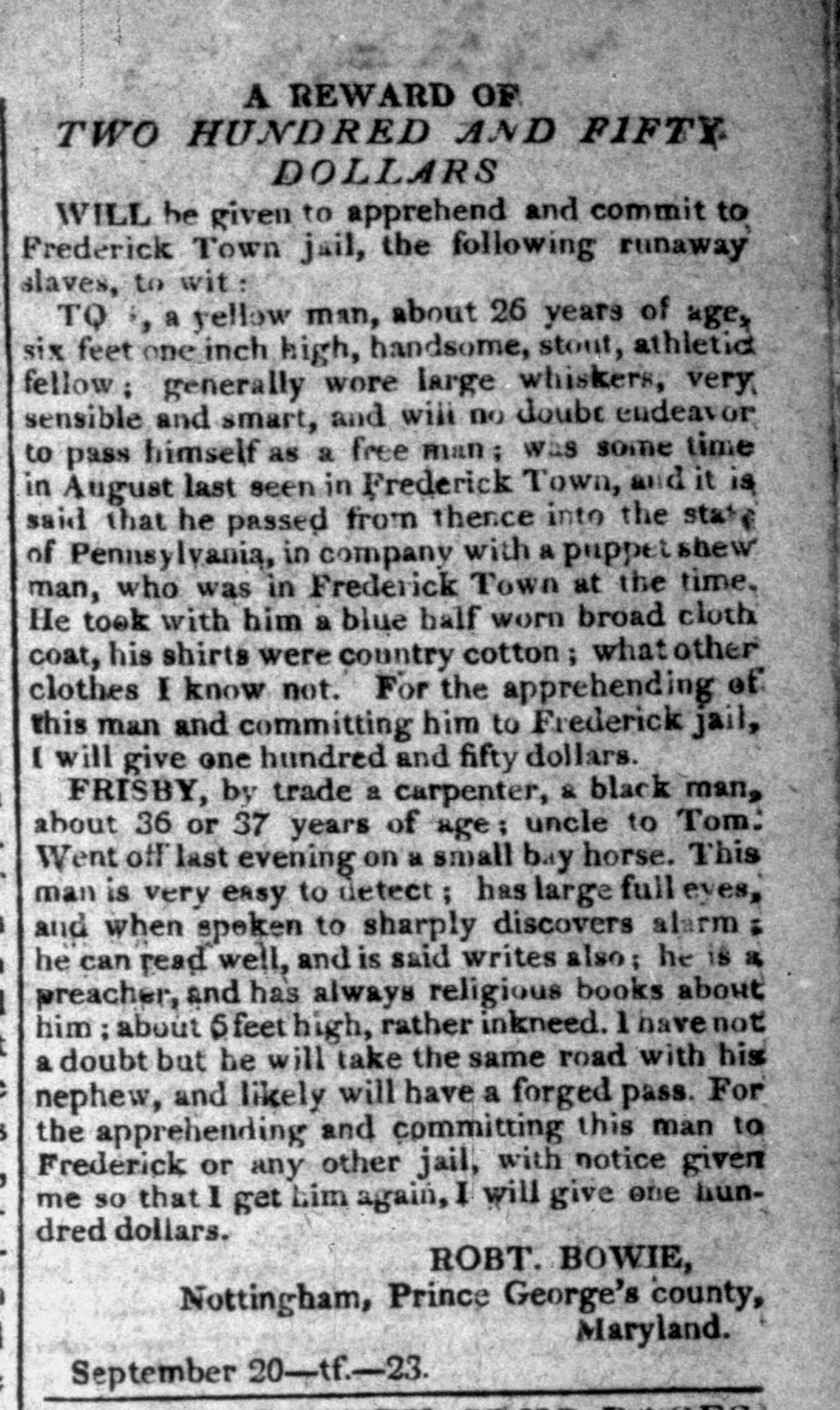
In the summer of 1813, a 26-year-old man named Tom took in his first breaths of freedom amidst the heavy, heat-laden air of Prince George’s County, Maryland. Acting before a lifetime of forced labor and age could completely steal his wits and athleticism, Tom escaped. According to the advertisement posted by his enslaver, Robert Bowie, Tom was last seen with a “puppet show man.” Whether this connection lasted merely moments or longer, the escaped enslaved man and puppetter made an unlikely pairing.
A little over a month later, Tom’s uncle Frisby followed in the footsteps of his nephew by escaping. Frisby was described as “a black man, about 36 or 37 years of age; uncle to Tom,” and he took off on the back of a small bay horse. The next day, Robert Bowie purchased an advertisement for both Frisby and Tom. The advertisement highlighted the intelligence of both freedom seekers. Bowie described Tom as “very sensible and smart,” and then noted that Frisby “can read well” and is “said” to write. Though not illegal, teaching enslaved people to read in Maryland was highly discouraged.[1] Indeed, literacy was a threat to the supremacy of enslavers over the enslaved. Despite the risks it carried, Frisby had boldly learned to read and write.
Frisby had developed a strong religiosity, perhaps shaped by his ability to read the Bible, and he had learned a trade. Bowie described Frisby as a “preacher” who “always has religious books about him.” Faith could offer enslaved people solace, as well as an opportunity to lead their communities. As an enslaved, literate preacher, Frisby’s faith would likely have been well known in his community. In some cases, enslaved preachers instructed their fellow bondsmen and women and led them to conversion.[2] Frisby’s escape surely meant the loss of an educated, spiritual leader. However, enslaved preachers could also encourage the sense of self-worth among enslaved people, as well as a firm belief that all people were equal before God. While religion could encourage obedience, it could also nourish rebellion.
Frisby’s skills in carpentry lent him a degree of autonomy that was not available to most enslaved people.[3] Frisby may have been able to work for clients other than his enslaver, perhaps living for extended periods elsewhere, and then paying his enslaver most of the money that he had earned. This would have increased his independence from the traditional surveillance of enslaved people in enslavers’ houses or on their plantations. Working outside Bowie’s estate might also have increased his knowledge of the local area and helped him forge connections with other enslaved people, all of which could have helped his escape.
Tom and Frisby worked for one of Maryland’s oldest and most prominent families. Looking beyond this simple advertisement, the Bowie name tells a story of slavery, wealth, and Maryland high politics. On March 1st, 1750, Robert Bowie, son to Allen Bowie Jr., had been born into the Maryland political elite. Robert Bowie served several terms in the Maryland House of Delegates before making his way to the state’s highest political office, serving two terms as governor.[4] But behind the grandeur of the Bowies’ status and political power was a system of abuse and suffering. Robert Bowie had inherited an estate about two miles from Nottingham known as “Mattaponi,” where an untold number of enslaved peoples were forced to live and labor.[5] Tom’s and Frisby’s work for the Bowie family is unclear. Given Tom’s young, athletic abilities, it is quite likely that he had lived and worked on the plantation, performing manual labor.
The Bowie family’s planter status offered greater security to Tom and Frisby’s social and family connections. In a system where humans were bought and sold as property, the social and kinship networks that enslaved people developed could easily be dismantled. Had they been able to form a bond under the conditions of slavery, the threat of separation was lower for Tom and Frisby than was the case for a family enslaved by a less well-off slave owner. Yet sale as punishment was as common among elite as it was among poor enslavers, so the risk of familial separation remained.
Tom and Frisby, nephew and uncle, were united by their blood and bondage, but to what extent? Robert Bowie writes that Frisby, “will take the same road as his nephew.” Had Frisby fled a life of slavery because Tom had recently done the same thing? Was it realistic to assume that the two men had plotted a joint escape, and perhaps reunion somewhere beyond Prince George’s County? Tom was a “yellow man,” meaning he had both White and Black ancestry, and could potentially “pass himself as a free man.” Frisby, however, was “a black man” and thus less likely to successfully pass as a free man: mixed race people were a little more likely to be freed by White people. Whether their different racial profiles made it easier or more difficult for Tom and Frisby to find freedom together is unclear, but their familial bond elicited suspicion from the man who owned them.
The state’s significant free population could also have kept Tom and Frisby in Maryland. In fact, by 1810, Maryland had the largest free Black population in the country. Free Black people accounted for nearly 33% of Maryland’s overall Black population.[6] How Tom and Frisby envisioned their lives as free men belonged to them, and their courageous pursuit of freedom remains immortalized in the 272 words of a newspaper advertisement in a Washington D.C. newspaper.
View References
[1] Maryland State Archives. Legacy of Slavery in Maryland: FAQs. Maryland State Archives. (n.d.) https://slavery.msa.maryland.gov/html/research/frequently-asked-questions.html
[2] Albert J. Raboteau, African American Religion, (New York, Oxford: Oxford University Press, 2001), 27.
[3] Barbara J. Fields, Slavery & Freedom on the Middle Ground: Maryland During the Nineteenth Century (New Haven & London: Yale University Press, 1985), 27.
[4] Walter Worthington Bowie, The Bowies and their kindred. A genealogical and biographical history (Washington: Press of Cromwell Bros., 1899) https://archive.org/details/bowiestheirkindr00bowi/.
[5] Ibid. 40-43, 84.
[6] Fields, In Slavery & Freedom on the Middle Ground, 1-2.